Sunday, April 1, 2012

Love as a Verb


I was lucky to be born into an animal-loving family -- especially, my grandmother.
 
My grandmother grew up on a farm in Ireland.  Not only did she value and appreciate animals, but she also had "down home" knowledge about how to care for and treat any creature who was suffering or injured.
 
Once, when I was around 8-years old, I found a pigeon with a broken wing.
 
I scooped up the injured bird and brought him home with me.
 
My mother was skittish around animals other than dogs and didn't know what to do.
 
But, my grandmother looked at the pigeon, immediately figured out how to treat and commanded me to run to the grocery and buy a couple of popsicles. 
 
She then delicately prepared a splint for the pigeon out of popsicle sticks.
 
We kept "Chipper" in a large, cardboard box on our fire escape lined with papers, towel and plenty of food.
 
As the weeks passed, Chipper's wing began to heal and my grandmother removed the splints.  He then tested out his flying skills by flying through the halls of our apartment.
 
I can still remember my mother screaming,  "Jesus, its like having a BAT!  Eeeeeh, get him out of here!"
 
But, as the winter turned to spring, nature issued its call to Chipper and completely healed, he eventually flew away.
 
But, Chipper did not go far.
 
He found a mate and remained around the trees and yards in back of our building for years.
 
When wanting to say "Hi" or "thanks" to my grandmother for saving him, Chipper periodically dropped by our window for a special treat and to let us know he was OK.
 
About a year following Chipper's rescue, I found a stray cat and brought her home.
 
Once again, my mother was nervous and afraid as she knew nothing about cats. (Cats were not a common apartment pet in the 50's.  This was in the days before cat litter and spay/neuter.)
 
But, my grandmother ridiculed my mother's fears ("What's the matter with you?  Its just a CAT for Chrissakes!")   "Nanny" created a litter box from an old baking pan, lined it with newspapers and immediately warmed up a bowl  of milk for the new household pet.
 
Fortunately, cat tuna was available in those days.  And "Kitty Kelly" would spend the next 16 years of her life dining on tuna and leftovers and getting her bowl of warmed up milk every day (which she daintily consumed by dipping her paw in the milk and licking it off).
 
When my grandmother's 17-year-old shepherd mix died in 1956, relatives gave to her their one-year-old, purebred Cocker Spaniel as a "gift." 
 
But, "Taffy" had issues.
 
Primary among them was biting people who attempted to pet him.
 
Taffy bit everyone who came into the apartment -- including my mother and myself.
 
As much as my mother was afraid of Taffy and wanted him gone, Nanny wouldn't hear of it.
 
"Don't be such a BABY!  You just have to understand and be patient with him!"
 
I eventually learned to understand Taffy.   He didn't like hands coming towards his face and was basically a "fear biter."  I learned to pet Taffy sparingly and only on the sides. I also learned that Taffy loved to run.
 
Many nights I ran with Taffy up and down the streets of New York City. And on those nights I wasn't running with the "crazy" Cocker Spaniel, my grandmother would take us both for  long walks and buy me an ice cream cone at "Addie Vallens." (I still remember those sumptuous pistachio and coffee ice cream cones!)
 
And so we kept the biting spaniel for the seven years that Taffy lived, eventually succumbing to cancer.  
 
And though my mother was almost sued when Taffy bit a woman on the street and everyone said we should have "gotten rid of" him, my grandmother remained steadfast in her devotion to him and was totally heartbroken when Taffy died.  She was inconsolable.  
 
The fact is, Nanny was the one person Taffy never bit.
 
I think about all these memories today because, although coming from an animal-loving family, both, my grandmother and uncle occasionally liked to fish.
 
Once when I was around seven, my aunt and uncle invited my grandmother and me to their summer home at fire Island.
 
I loved the ocean and spending the summer at Fire Island was a huge treat.
 
But, it turned into a somewhat "traumatic" experience one day when my grandmother and uncle took me fishing with them at the bay dock.  My uncle pulled a little snapper fish out of the water.   The fish flopped all over the wooden dock and I imagined it struggling for breath and "drowning."
 
I immediately broke away and ran screaming and crying to my grandmother.  "Stop it, stop it!  The fish can't breathe!"
 
Though my grandmother attempted to comfort and console me, I never went fishing with her or my uncle again. Rather, we elected never to speak about the subject from that point on, while still maintaining the integrity, love and respect of the relationships.
 
To this day, I don't like the sight of struggling fish pulled out of water and usually look away.
 
But, I also understand that nature itself is harsh and little fish get eaten by big fish all the time.
 
Neither my grandmother nor uncle were cruel people and both truly loved animals.
 
But, for some reason, that love or what some might say, "hyper sensitivity" to animal suffering went a little further in myself.
 
Yesterday, I wrote a critical blog entry against what I perceive to be, the cruelties and "abuses" of some fishing in city parks.
 
Perhaps I just don't understand the appeal of fishing, though am very familiar with the accolades and promotions for it.  ("Relaxing, recreation, time with friends or family, outdoors," etc,, etc.)
 
I think I have simply never liked the idea of doing to others (animals or humans) what I would not like done to myself -- with the exceptions of self-defense.
 
So, no, I don't like fishing, but understand that some people do -- including my own beloved family members and other loved ones.
 
What makes the fishing in parks intolerable (to me) is when rules are ignored and broken and the fishing causes harm to the fish and other wildlife -- especially carelessly discarded fishing lines that ensnare birds.
 
Whether one likes or engages in fishing or not, it seems reasonable to expect and require that the laws and rules that govern it in city parks be respected and obeyed.  Even my grandmother and uncle (God rest their loving souls) would agree with that.
 
My grandmother died in 1969, my mother in 1996 and my uncle in 2007.
 
Rarely a day goes by that I don't think about and miss them.
 
My grandmother, especially, had a way with animals and a deep, abiding love for them -- though I don't recall Nanny ever actually using the word, "love" -- even to me or her own daughter.
 
Its interesting how culture changes over the generations and decades.
 
Then again, "love" is a verb requiring and shown in action rather than declaration. 
 
My grandmother lived love rather than actually ever speaking it.  -- PCA
 
                                                         
                                                        *******

Saturday, March 31, 2012

"If You See Something Say Something" -- Becoming the Squeaky Wheel for Wildlife


(Photos: -- Fishermen at the Boat Lake this past week.  They kept the fish out of the water at least five minutes and only threw the fish back when I took out camera.  2-- Mama and Papa at Boat Lake yesterday.  But, will these two already lame geese be safe from discarded fishing lines carelessly left around grounds and pedestrian paths?)
 
 
They arrive in the spring and they stay and stay and stay until seemingly the last summer leaf has fallen to the ground.
 
No, I am not talking about geese or ducks or robins.
 
I am talking about the fishermen whose presence in Central Park is already marked by a crippled sea gull at Harlem Meer hobbling around with at least six feet of fishing line attached to his/her leg.
 
The gull can however still fly, making rescue to remove the fishing line (or even getting a good photo) nearly impossible.
 
During the past week, I have noted fisherman trespassing the "off limit" areas of Central Park, smoking cigarettes (supposedly not allowed in city parks), leaving empty soda bottles in the grass and keeping captured fish out of the water for at least five minutes while the fishermen strike poses and hog for photos.
 
A few days ago a guy was fishing off the small dock at Turtle Pond.  There were at least 30 turtles in the water where the man slowly lowered his fishing line.
 
"Are you trying to hook a turtle?" I asked, perturbed by what I was seeing. 
 
"There's a bass somewhere down there." the man replied belligerently.
 
"You shouldn't be fishing directly where there is an abundance of wildlife." I answered, annoyed at that point.
 
"I am within my rights to fish here!" the man shot back.
 
"Well, fishing at Turtle Pond was NEVER allowed in years past and shouldn't be now!" I answered while taking out my camera to take a photo of ducks.
 
"You can't take a picture of me!" the man shouted defensively.
 
"I wasn't planning to!"
 
I wanted to add, "You ugly jerk!" but didn't.  
 
Instead, I walked away as the confrontation was beginning to get nasty.
 
Still, while witnessing all these infractions this past week, it was the crippled seagull at Harlem Meer that finally propelled me on a journey of seemingly endless calls to various city and state agencies to register a complaint about abusive and unmonitored fishing in Central Park.
 
One tends to discover in "bureaucracy" situations like this, one gets shuffled around and constantly advised to call someone else.
 
And so, in less than two days, I talked to a Park Ranger, officials from the DEC, Central Park Conservancy, Dept of Parks and Recreation, the Dana Discovery Center (located at Harlem Meer) and registered an official complaint with 311.  
 
I am normally a person who never complains to city and park officials about anything. 
 
But, the slaughter campaigns against geese over the past few years and the continual crippling and harassment of wildlife in our city parks by fishermen has turned me into a kind of crusader.
 
Of the people I spoke with, a woman from the DEC (Department of Environmental Conservation) and another woman from the Dept. of Parks and Recreation were the most helpful, supportive and offering of sound advice.
 
That advice being that one indeed has to become the persistent "squeaky wheel" and immediately report ALL violations first, to 311 and to the other agencies in charge of managing wildlife and law enforcement in the parks. 
 
(The DEC has a special number to report fishing violations when immediately witnessed: 1(800) TippDEC.  1(800) 847-7332.)
 
"They will put their resources where they are most demanded and required." I was advised.
 
I indeed hope that is the case.
 
Because another summer of watching crippled birds hobbling around with fishing lines on their legs, hooked turtles and discarded fishing lines left on pedestrian paths and grass to ensnare dogs or humans (as occurred with my dog, Tina and me last summer) is simply intolerable and unacceptable.
 
Become the eyes and mouths for the wildlife in your parks and be sure to snap photos when possible and make the appropriate calls.
 
We all have to become the "squeaky wheels" for the fish, turtles and birds who cannot defend  themselves nor remove the fishing lines ensnared around and crippling their bodies and feet.  -- PCA 
 
 
                                                               *************  


Monday, March 26, 2012

Joy Rides and Returns to the Nests


(Photos:  1-- Buster and Brianna. One last fling and joy ride before the call? 2-- The gosling from last year.  3-- The Reservoir geese, returned?)   
 
 
The first sight encountered yesterday when arriving to Harlem Meer on a brisk, but beautiful spring day, were three mallards frolicking in the lake.  
 
The mallards took off from the water and flew in a high, wide circle all around the Meer twice -- only to eventually return and land back in the water, not far from where they originally took off. 
 
One mallard landed about 30 feet from the other two, but quickly flew back to them.
 
I guessed this was the duck equivalent to a "joy ride" for humans.  Flying around for the sheer enjoyment and fun of it.
 
I have noted that kind of "flying around for the hell of it" numerous times over the past five or six weeks among the ducks and geese of Central Park.
 
This is not a season the birds have to worry about conserving energy or fattening up and so it seems they are using much of their time either catching up on rest, staking out territories or just seeking adventure and play.
 
Unfortunately, the Bradley Brigade (Brad, Piggly and Wiggly) the three domestic ducks presumably left by humans at the Meer can never know the joy of just flying around for the heck of it, as they cannot fly more than a few feet. 
 
But, they have their own ways of finding fun.
 
These days, it seems Brad and Piggly are in constant conversation with each other over how to run things at the Meer and Brad particularly loves giving the mallards a hard time.  Sometimes, Brad even goes off on his own just to let the mallards know who is the boss at the Meer. But, "the three duckateers" also find those little spaces in time and place to just rest and relax.  There is a little fenced in area by the Dana Center that is particularly nice and safe for Brad, Piggly and Wiggly to grab quick afternoon siestas together.  
 
Yesterday, I was at first concerned when seeing Brad by himself on the lake keeping the mallards in line.  But, then a few minutes later, he rejoined his pals, Piggly and Wiggly and the three went proudly swimming off together.
 
I then noticed what looked like a small gaggle of geese on the small, sandy eastern portion of Harlem Meer.   I walked over to check the geese out.
 
It was a family of five geese.   After securing my two dogs to a park bench, I walked a little closer to the geese and surprisingly, two of them began to approach me as if in recognition.
 
The gander of the two confidently walked up to me in greeting and gently took sunflower seeds from my hand!
 
His mate also walked up, but bowed her head and shyly turned away from offered hand treat, preferring to eat seeds off the grass.
 
It did not dawn on me at first who these geese actually were, but it was clear they were familiar.
 
The three geese who I presumed to be the offspring of the "dominant" pair took respectfully to the edge of the water, but also watched as if in recognition.  I approached them, but like the mother goose, they declined to take anything from my hand, electing to nibble at the seeds in the sand.
 
It was only when I began to walk away and noticed the gander suddenly admonishing the youngsters when they attempted to walk into the "space" of the parents, that I realized the family was Buster, Brianna and their grown goslings!
 
Apparently, the family returned to Harlem Meer for what I guess to be a brief visit or "joy ride?"
 
Its been at least six or seven weeks since seeing Buster and his gaggle who I had so became familiar with and fond of over the winter.  As soon as the first warm hints and buds of spring began to appear, Buster, his mate and "kids" left Harlem Meer.  
 
Had the family been "harassed" out from where they had spent the last month and a half or had Buster and flock simply used a lazy Sunday afternoon to go "pond hopping" and check out their old haunts?
 
I of course had no way of knowing the actual answers to the questions. It was just really nice to see Buster, Brianna and the "kids" again.
 
But, my sense is that they will not be staying for long at Harlem Meer.
 
Walking back from the Meer, through the North Meadow and the Reservoir, I thought back to last spring and summer and remembered the two geese who raised three goslings at the Reservoir then.
 
I had not seen any geese in the Reservoir over the past six weeks or so and wondered if the family might not return?
 
But, then as I approached the 90th street exit of the Reservoir, I suddenly noticed a pair of obviously mated geese in the water.
 
The geese and ducks don't appear to be actually "nesting" yet, but all the "joy rides" and moving around may indeed represent the preparations.
 
Spring is not only the time for rest, play, staking out territories and joy rides, but also the time for romance and returning to the nests.
 
One cannot be sure, but it appears the Reservoir geese are back and Buster and Brianna will be soon to go again.
 
Perhaps yesterday simply represented one last fling -- and joy ride before the real responsibilities and challenges of the spring set in.  -- PCA
 
                                                               **********


Saturday, March 24, 2012

Let Sleeping Ducks Lie


(Photos: Brad, Piggly and Wiggly catching up on needed rest the other day.  A goose and duck couple relishing rare and special moments of the year.)
 
It seems that every year brings with it, a very small and peaceful window of time that allows for rest, renewal and lightheartedness.  
 
For most birds (and other wildlife) that tiny window of opportunity and wellbeing is the early spring.
 
It is a time when the bounties of food and pleasant, nurturing weather are plentiful and a time prior to the challenges and stresses of raising young.  
 
So it was, when most recently visiting Harlem Meer that almost all the birds were either resting peacefully or playing in the water.
 
A group of starlings madly splashed and seemed to be having the time of their lives by the lake.  One could almost hear them laughing as they bobbled up and down in the water like small children splashing in swimming pool on a summer's day.
 
Several pairs of mallards were sitting together by the embankments and one duck pair strolled romantically on a grassy lawn.
 
And there was one goose pair who enjoyed sunbathing and preening together under a tree by the Dana Center as if they did not have a care in the world.
 
But, perhaps the greatest surprise of all was the "Bradley Brigade."
 
I found all three ducks plopped on the grass in the fenced in area near the Dana Center.
 
They were actually sleeping in the middle of the day!
 
In all the months of seeing Piggy and Wiggly, I have never seen these birds actually relaxing.
 
And I would have to go back to the early spring of last year to recall Brad resting in the grass.
 
Then again, it made sense.
 
This is not a time the ducks or geese have to spend all of their days foraging for food. Nor is it a time where they have to constantly swim in order to try and keep warm or prevent the lake from freezing over.
 
There are no little ones yet to watch over and protect.
 
And there are no preparations to make (i.e, fattening up) for what could be a cruel and meager winter as the birds have to do in the fall. 
 
When seeing all the serenity and relaxation around me, my heart lightened and warmed to match the sunny and beautiful 75 degree day that surrounded.
 
And although having some treats in my bag, I decided not to arouse the three sleeping and peaceful ducks.
 
It is such a small window of time that they get nurturing and caressing days like this past Thursday and Friday, that it was better to let the sleeping ducks lie and catch up on needed rest.   
 
And indeed, today temperatures have slipped to the low 60's and next week they will drop down to seasonable levels. (50's)
 
But, for those few special days of the year when almost everything is perfect, non-demanding and non-threatening, wildlife does get its chances to just kick back, rejuvenate and renew. 
 
I bet the animals are thinking, "That only life could be like this all the time!"
 
Or, more likely, they don't have to think at all -- just enjoy for the brief time they are blessed with the peace and wonder of these few special and magical days.
 
 
                                                             ***********


Thursday, March 22, 2012

Feasts and Famines


(Photos: 1-- New goose pair at the Boat Lake.  Though they came to greet a human offering treats, they spent their time preening on rock, while turtles enjoyed a "feast."  2-Mama and Papa on different rock preening and resting.)
 
Some good news coming out of both, the UK and Lacey, New Jersey the past couple of days.  Both locations have decided to shelve planned culls of geese in favor of allowing non-lethal population control measures sufficient chance to work.   For the latest updates and news articles on these and other noteworthy events, please go to our Facebook page:
 
 
Closer to home, migratory populations of geese have seemingly all left Central Park along with most of the mallards who wintered there since December.
 
The other day I walked around the Reservoir and Turtle Pond where just a few ducks were observed and no geese.
 
At the Boat Lake in Central Park, it was however, a different story.
 
I counted a total of nine geese (ironically, the same number that molted at the Boat Lake last summer.)    This number includes the Boat Lake goose family (Mama, Papa and their three youngsters hatched at Turtle Pond in 2010) and two pairs of seemingly "new" geese.
 
I was a little surprised that the family was still at the Boat Lake as usually in March, they return to Turtle Pond (the site of nesting and previous successful gosling raising).
 
The fact that the family still hasn't returned to the pond is bewildering.  I am not sure if this means that Papa and Mama will not attempt to nest this year (they are after all, a little along in years) or if they are delaying return for some reason.   Last year, something happened to the eggs that Mama was sitting on near Belvedere Castle and they didn't hatch. (The geese are usually also subject to harassment at Turtle Pond during the spring and late summer and fall.)
 
So, the fact the family is still at the Boat Lake leads me to believe they might attempt to stay there through the summer.  But, whether the parent geese attempt to nest at the Boat Lake or not seems questionable.   
 
Their behavior the other day did not seemingly indicate either an existing nest or preparation for one. Mama and Papa were mostly hanging out and preening themselves on the familiar rock in the water where they usually slept last summer along with the other geese who molted with them.   Their three youngsters were also on the rock the other day, but in a lowered position on it (family hierarchy and rule?)
 
I had hoped that Mama and Papa might swim to the rock on the other side of the lake where I usually see them and occasionally offer treat and take photos. 
 
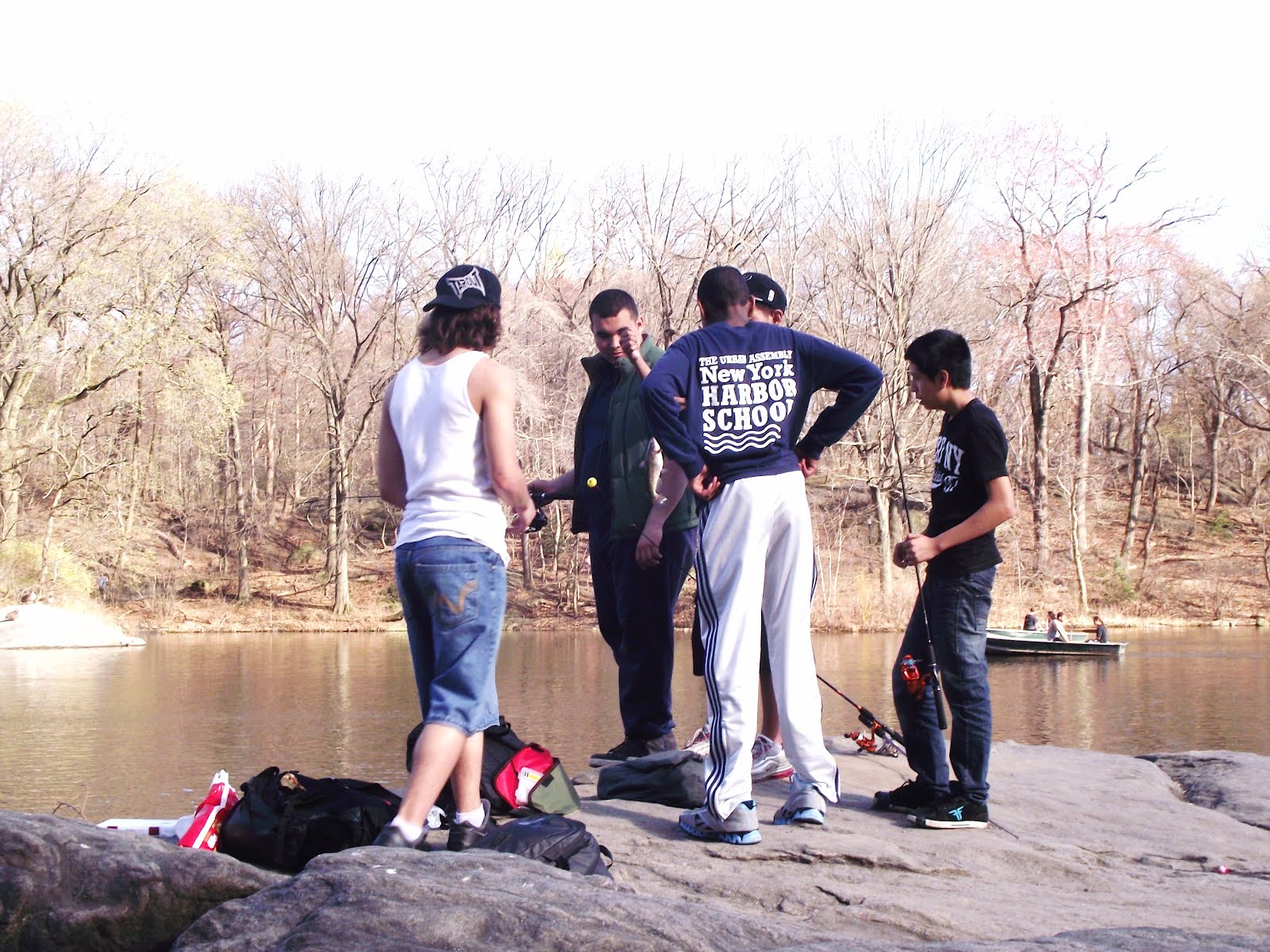
But, there were five young guys fishing on that publicly accessed area and the geese and ducks kept distance from it.
 
There were also many people boating the other day due to the beautiful and unusually warm weather.
 
Although the geese are very used to boats, it seemed they opted more for relaxing and preening than navigating through so much (perhaps unexpected) human activity so early in the season.  
 
The other geese on the boat lake were paired off and also mostly resting and preening.
 
A cyclist stopped to sit and rest on another publicly accessed rock.  The man tossed some bits of bread towards one pair of geese in the water and they then gregariously joined him on the rock.
 
But, the geese did not show any interest in the offered food. 
 
Instead, they preened themselves, while turtles appeared to grab the small bits of bread floating in the water.
 
In essence, what has been observed at Harlem Meer over the past couple of weeks is also occurring in other sections of Central Park.
 
Migratory populations of geese and ducks have left to return to spring and summer breeding or molting grounds.  The remaining "resident" geese and mallards are mostly paired off these days and concerned with preparations for either breeding or summer molting (all that attention to preening). 
 
And with all the new spring blooms and plentiful food supplies, it seems the last thing the birds are interested in are offered human treats.
 
I wonder if the geese and ducks sometimes say to themselves, "That only humans were so generous over the winter!"  
 
Too bad the waterfowl can't "squirrel" away the treats offered during fair weather for those days in January and February when neither food nor generous humans are plentiful.
 
"Feast or famine" it must seem to them. -- PCA
 
 
                                                              *********
 

Tuesday, March 20, 2012

"Too Much Of" -- A Photo Frozen in Time


"To feed or not to feed. That is the question."
 
The play on Shakespeare's words has been on my mind lately as I have cut back drastically on the black oiled sunflower seeds and other goodies I normally take when visiting the ducks and geese at Harlem Meer.
 
That's because there are very few waterfowl to actually offer the treats to in recent days. And the few who are there are not particularly hungry.
 
Even the normally voracious Piggly and Wiggly last night failed to consume all the seeds offered to them.  As for Brad, their leader, he hasn't taken anything from my hand for some days.  Brad's attention these days is fixated on any mallards who happen to wander into the "space" of himself and his two charges.
 
Food is obviously way down on the list of priorities for the ducks and geese during the spring.  There is plenty of it all around them with all the new spring blooms and they no longer have to "fatten up" in anticipation of a bleak winter. For now, the birds can afford to take for granted what they have plenty of.
 
Feeding of waterfowl is of course, a big "no no" for officials in charge of running most parks and particularly those who have it in for the geese.
 
Adults and kids "guilty" of feeding geese are in fact, frequently blamed for whatever "overpopulation" of geese that is perceived and claimed: 
 
"If people feed them, they will never leave!"
 
Of course the statement quoted is no more true of geese than pigs sprouting wings and suddenly flying.
 
Geese don't stay in an area any more for human-offered treats than humans live in a community because of a particularly good local pizza parlor.   It may be nice to have a good pizza parlor, but that doesn't impact human life and resident choices.  (What does impact geese's decisions to "stay" or leave an area are, 1- safety, -- especially to raise young. 2-- access to water and open spaces. 3-- availability of natural food sources, especially short grass.)
 
Those towns and communities wasting money to put up "No Feeding" signs might as well use it to build nice pizza parlors instead.   Both will have exactly the same impact (none) on the population of Canada geese.
 
I did not in fact, see any geese at Harlem Meer last night -- this despite my feeding of ducks and geese there every night since late last fall.
 
Buster and his gaggle (the goose family I did feed every night) left the Meer weeks ago.  And even the one bird, Chrissy (the lame duck) I really thought would stay due to her perceived "dependence" on me for food left with her flock a few days ago.
 
The reality is that when their biological clocks and the calendar says, "go" the geese and ducks go -- and it would not matter if humans were feeding them caviar and champagne around the clock.
 
I am sometimes amazed at the preponderance of misinformation and falsehoods about the wildlife that lives among us.
 
Indeed, it seems wise to speculate that most people know far more about the exotic wild animals, birds and fish living amongst the Arctic ice throws, African jungles or even the bottom of the oceans than we do, the pigeons, geese, ducks, squirrels or raccoons who actually live among us!
 
Apparently, our city wildlife is not interesting enough to do documentaries on or write books about. 
 
But, its apparently OK to wage extermination campaigns against them -- or blame any human feeders for an imagined "overpopulation" of the animals.
 
Some things in life I will never understand.
 
Then again, perhaps it all boils down to this thing of "taking for granted (and not taking time to really know) what we have plenty of."
 
Even the ducks are somewhat indulgent in this behavior as witnessed last night.
 
But, come the fall, the ducks will be tripping over themselves to get to what is now plentiful and can be taken for granted.
 
The question is, will we too, one day lament the loss of what is now claimed "too much of" and even scorned?
 
Oh, how things can change with the seasons!
 
What was true yesterday, is not true today.
 
And what will be true tomorrow is apparently beyond our wisdom and insight to see now.
 
"Too much of" seems relevant merely to time and season -- like a photograph frozen in moment.  -- PCA
 
                            
                                                                     ************
  

Sunday, March 18, 2012

The (Spring) Urges to Merge and Procreate


(Photos -- Brad, Piggly and Wiggly yesterday around the egg.) 
 
It seems that Wiggly might have laid an egg! 
 
But, more about that later......
 
With the official arrival of spring now less than a week away, the movements and changes occurring at Central Park are happening at greatly accelerated pace.
 
The robins returned weeks ago.  Flowers are blooming in the park.  New green grass is growing through the old. And many of the trees are budding.
 
In recent weeks, waves of migratory geese and mallards moved through Central Park Some stopped for brief rests, but almost all have now left.
 
Meanwhile, some of the "resident" geese and ducks of Central Park have also returned to whatever locations they normally breed and/or molt.
 
A few days ago, there were as many as 15 geese at Harlem Meer.
 
As of yesterday morning, the number had fallen to 6.
 
Many of the mallards have also left Harlem Meer in recent days.
 
Among them, whatever flock Chrissy apparently belonged with.
 
I was worried a couple of nights ago, when not seeing Chrissy arrive for her nightly treats.
 
But, neither did the Bradley Brigade show up with their chatterings and beaks out beseeching treat.
 
In fact, the few mallards who did come, seemed more interested in hierarchy displays and territorial battles than actually scacking.
 
Gone are the bitter, wintry days when the mallards would fall over themselves at my feet trying to grab whatever seeds hit the ground.  (Food, being scarcer in the winter and more necessary for the birds to maintain heat and fat reserves is the main priority for them during the short, dark days from late fall through the frigid days of January and February.)
 
But, now food is plentiful and focus shifts to pairing off and mating as well as territorial battles and establishing one's place in the flock and terrain.
 
Nevertheless, concerned over not seeing my familiar ducks the other night, I walked all around the Meer in effort to find them.   Brad, Piggly and Wiggly, being domestic, flightless ducks had, after all, to be somewhere around the lake.
 
I did finally find the "Three Duckateers" towards the north east side of the Meer -- the area near the Dana Center where Brad typically hangs out during the warmer months.
 
And Brad was very busy staking out the territory and giving some of the mallards a rough time by chasing them down and sending them away in the water.
 
In recent weeks, Piggly (the other male duck of the three) has joined Brad in intimidation tactics, though he is still mostly in the learning process from Brad.
 
For her part, Wiggly stays out of the frays and is still mostly preoccupied with eating and staying close to the boys.
 
But, I still had not found Chrissy, the crippled mallard and the one who has quickly warmed herself into my heart over the past several months.
 
Frustrated and worried over not finding the pretty little familiar mallard, (who though lame, can fly) I planned to return the next morning when daylight might make the quest a little easier and more successful.
 
Bright sun burned through an early morning fog yesterday.
 
By the time I arrived to the Meer it was easy to see all of the waterfowl on the lake.
 
I was surprised by the low number of geese and ducks.
 
Six geese, spread out mostly in pairs, and perhaps 20 to 30 mallards on a lake that during this past winter had as many as perhaps a couple of hundred of both, migratory and resident ducks and geese.
 
I wondered if Central Park might have returned to goose harassment over the past few days?
 
Its possible of course. But, the fact there were six geese on the water, along with a couple of dozen mallards made me doubt that.
 
Remembering back to last spring, (and looking through blog entries from this period) many of the ducks and geese gradually left Harlem Meer, though at a later date than now.   (Then again, everything is "earlier" this year due to the unusually warm weather.)
 
Once again, I walked around the lake and quickly found Brad, Piggly and Wiggly in the same area discovered the night before.
 
And once again, Brad was vigorously chasing mallards away, both in the water and on the grass.
 
But, as I walked closer to the three ducks who by that time were on a grassy area by the water, I noticed something very unusual.
 
An egg!
 
The egg looked like a ordinary chicken egg that are readily available in grocery stores.
 
But, what human would leave a chicken egg in the park?
 
Moreover, all three ducks were near the egg and Brad particularly seemed obsessed with keeping the mallards away.
 
Trying to make sense out of something that seemed senseless, I could not imagine Wiggly laying an egg in such an open and vulnerable spot!
 
There is no nest around the egg and the domestic female duck was not sitting on it.  Moreover, any eggs (or duck sitting on them) in such open and unprotected area would be sure invitation to a raccoon or dog.
 
But yet, all three ducks would not leave the area!
 
Perhaps in being a domestic, rather than wild duck, Wiggly has no sense about laying eggs in a protected and safe area?
 
Regardless of the efforts of Brad and even Piggly to protect the territory, its hard to imagine the egg having any chance of survival.
 
Wiggly didn't seem to have either a clue or interest to even sit on it.  Then again, it would be dangerous for her if she did. Too many dogs and human activity in the area. And at night, there are the raccoons.
 
In previous years, I always wondered why Angelina who was the apparent mate and constant companion to Brad never produced ducklings?
 
But, its possible that yesterday, I got an answer.
 
Domestic ducks may not have the instincts and wisdom to know where to safely nest and lay eggs in an outdoor, challenging environment, as the mallards do.
 
In fact, as previously noted, Harlem Meer is not normally an area where geese nest or even mallards produce many offspring.
 
For all the mallards who typically come and go or even stay at the Meer throughout the year, only three to four successfully produce ducklings each spring and summer. (And so far in my observances, no geese have produced goslings at Harlem Meer.)
 
Perhaps that explains why most geese and mallards have now left Harlem Meer, including Chrissy and her flock.
 
It is presumed that in coming weeks, the six geese currently at the Meer will also leave.
 
Indeed, the only waterfowl who have no choice other than to stay are the three domestic ducks, Brad, Piggly and Wiggly.
 
And seeing what I did yesterday, (if true that was an egg from Wiggly) there is virtually no chance that these three domestic ducks will reproduce -- despite the earnest efforts of Brad and even Piggly and Wiggly to do so.   -- PCA
 
                                                              **********