Wednesday, July 19, 2017

Family and Social Structure -- Thy Name is Canada Goose


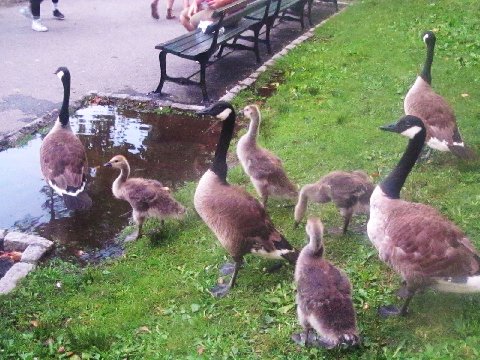
Though it may appear random, these are actually two separate goose families raising their goslings together.
Mama goose (Greta) attacking and delivering stiff "correction" to hapless goose who wandered too close to the family.
Temporarily vanquished. No harm done, but stiff corrections for young goose forced to learn the rules of goose hierarchy and social order -- the first of which is "Never mess with the family."  
Proud daddy, Hansel and one of his now nearly fully grown goslings at Central Park Reservoir. The babies will soon be flying.
 
One of the most fascinating and informative aspects of observing Canada geese is their intricate social and family structure.

It might appear to the casual eye that a gaggle of geese on a lake or grazing peacefully on grass is a loose and random thing devoid of structure and order. But nothing could be further from the truth.

In fact, there is a very definitive hierarchy among Canada geese and those who attempt to test or challenge its order in any way can be in for rough corrections.  

At the very top of the hierarchy are the mated goose pairs with goslings. They essentially rule over all and have first claims to territory and food. So fierce are geese parents in protecting their young and providing the best in resources for them, that no other geese dare to challenge or even defend themselves if and when attacked.

And it is not only the gander who vigorously defends and wards off possible intruders into family space, but the mother goose hen as well. (This is especially true as goslings grow and no longer require the mother to constantly hover over them as is needed when the babies are small.)  

In the past few weeks, I have noted, for example, Greta taking on a much larger role in chasing off and even attacking those hapless geese who make the mistake of getting too close to the family at Central Park's Reservoir. Moreover, while her mate, Hansel is usually content to chase and pull some down feathers from the offending goose, Greta is far more relentless and even aggressive in her pursuit; often pushing the subordinate goose down in the water and continuing the chase on to land. "Mother goose" doesn't fool around as the name in human folklore implies.  

Below parental geese in hierarchy, are the older, established goose pairs without goslings. (But even they have to acquiesce to pairs with offspring.) It is common to see these geese chasing and administering "corrections" to younger geese or sometimes just going off on their own, away from the maddening crowd. 

At the very bottom of goose hierarchy are the young "singles;" particularly those yearlings from last year's crop of goslings who, not only have to withstand constant corrections from the group at large, but even their own parents.  (It is particularly brutal to observe parental geese vanquishing their offspring from the year before when they want to nest again in the spring. "Kicking from the nest" is not just a phrase.)

Established social order among Canada geese has not just played out at the Central Park Reservoir this summer, but also at the park's famous Rowboat Lake.  There, two mated goose pairs have (so far) successfully raised four goslings.

The interesting aspect about this set of circumstances is that one pair only had one gosling and the other pair had three. Amazingly however, both families meshed together (presumably for the overall safety of all the offspring) and as result, even the solitary gosling without siblings has survived. Such might normally be difficult in nature as geese are flock birds who almost always grow up with siblings. It seems in this case, the parent geese of the one gosling adapted and figured out a way for their baby to grow up with others. Fortunately for them, the other goose parents were accommodating. As the saying goes, "There is safety in numbers" and goose parents appear to know this all too well.

There are also five other geese at the rowboat lake, including the presumed parents (Man and Lady) of the two new goose mothers. They appear to be hanging out most of the time with three of their offspring from prior years as they did not successfully nest this year. But even the new grandparents now have to acquiesce to the two families with goslings.

Quite often all 13 geese can be observed in fairly close proximity to each other, but the five have to maintain respectful distance from the two families all the time. Hierarchy and structure matter in the goose world and they matter all the time.  

The reason for choosing this particular time to cover goose hierarchy and the particularly high protective status of goose parents with babies is due to the disturbing story covered in yesterday's blog.

That concerned a goose family with six goslings who were brutally rounded up on a woman's driveway in California by USDA Wildlife Services and sent to their deaths. .http://www.santacruzsentinel.com/environment-and-nature/20170715/scotts-valley-residents-appalled-after-eight-geese-netted-in-spring-lakes-park  

The story was particularly horrifying due to eyewitnesses descriptions of all the "blood" left in the aftermath of the assault. Normally, goose roundups result in lots of feathers strewn about, but not blood.

One has to conclude that either USDA hired brutal thugs to do the particular roundup or that the goose parents fought fiercely for their lives and those of their babies.

I personally surmise that both are tragically true. -- PCA


                                                             ***********

Tuesday, July 18, 2017

"Massacre in my Driveway" -- One Woman's Trauma at hands of USDA Goose Cull


Recently, a goose family like this was brutally rounded up (by USDA) from one California woman's driveway in what the traumatized citizen later described as a "massacre" leaving a messy trail of blood and feathers behind. One wonders how we as a civilized democracy have come down to this?
 
When Cindy Moore returned to her Spring Lakes home in Santa Cruz, California on June 21 of this year, she was greeted by a tangled mess of blood, feathers and feces that covered her driveway. She was unable to park her car until attempting to hose down what she later described as a "massacre in my driveway."

Ms. Moore later learned from area residents and eyewitnesses that during her brief absence, a USDA truck had pulled into the area and that agents for the federal government agency spent more than 20 minutes, chasing, terrorizing and eventually capturing a family of two parent Canada geese and their six goslings to haul away to their deaths.

Ms. Moore claims to have watched the goose parents raise their young and is now so traumatized by the assault (literally in her own backyard), she has put her home up for sale after living there six years.

A community newsletter, "The Spring Lakes Park Gazette" confirmed two days later, that USDA Wildlife Services had indeed "removed" the eight geese for the so-called "safety and health" of residents, a few of whom had apparently complained.

But four of Ms. Moore's neighbors sent letters of protest to all the residents of the mobile park and others spoke to the press on condition of anonymity out of fear of retribution.

One woman described a chaotic scene in which the two adult geese and their six babies were separated, chased, netted and dumped in a truck with one of the agents telling her the geese would later be "euthanized." Another witness stated "The geese were in distress as evidenced by the amount of blood, feathers and diarrhea."

One seriously has to wonder what kind of country we are living, in which a rogue government agency can suddenly sweep into one's driveway and conduct a bloody, lethal roundup of innocent wildlife without any notification to the property and home owners?

While known that the geese have no rights, one has to wonder about the rights of the people?

Sadly, clandestine goose roundups like the one in Cindy Moore's backyard or area parks around the nation are neither unique or rare.  On the contrary, they are common. Only a pitiful few ever garner attention from the press.

Here in New York City, USDA (secret) goose killings are no longer reported at all by the major media. On the contrary (as reported yesterday in this blog), New Yorkers were actually lied to this year when an article published in Crain's New York this past June falsely claimed that New York City geese were getting a "reprieve" this summer and would not be killed at all. (It's not clear at this time who from the "city" lied to the reporter of the Crain's piece as the author declined to name sources for his misinformation.)

We have since learned (no thanks to the press) that USDA goose culls did indeed occur in NYC over the past month, but USDA won't disclose how many geese were killed or from what parks and other city locations they were "removed."

It's past time for the citizens of this country to rise up against the barrage of misrepresentations, cover-ups, deceptions, false media stories that bear no accountability or duty to correct and most of all, rogue government officials and agencies (particularly USDA Wildlife Services) who contract for deadly wildlife "massacres" without ever bothering to notify the citizenry it is supposedly serving and "protecting."

It is truly a disturbing and bizarre day when people feel compelled to put their homes up for sale because of the trauma and memory of a bloody "massacre" occurring on their own doorstep. 

It's a day when the lies have come home to roost.  It's a day to recognize that if we cannot trust and have credibility from those in power, we have nothing at all.  

Our democracy is apparently on life support in more ways than one. -- PCA


                                                  ********

Monday, July 17, 2017

Despite False Promises, many New York City Geese Secretly Slaughtered in Recent Days


Young boy feeding and enjoying gentle goslings in Central Park.But in other parts of the city (including Jamaica Bay Wildlife "Refuge"), geese and their babies were secretly rounded up and sent to slaughter this summer. 


Sometimes it seems (especially over the past year) that our country is choking on a consistent diet of dastardly lies and obfuscations.

Though most of the concealments and untruths concern matters outside our immediate backyards, they are nevertheless serious and rightly cause concern over the legitimacy of our Presidential elections -- something at the bedrock of American democracy.

But sometimes the deceptions, misrepresentations and evil doings hit much closer to home. --  Right up to the grasses and lakes of our local city parks, for example.

On June 15 of this year, I published a blog entitled, "New York City Geese and Their Babies Get a Reprieve this year."  The blog quoted and was based upon an article appearing in Crain's (a normally credible news source) that stated "no Canada geese were to be culled in NYC this year." The geese were in essence, getting a "reprieve."

According to the piece, New York City would be embarking on a non-lethal program for goose management in 2017 that would not involve the direct slaughter or gassing of adult birds. Instead, the plan was for "egg and nest destruction and harassment" (bad enough on their own).

The problem is, the premise of this article was entirely false.

Canada geese were in fact, rounded up and killed in New York City this summer.

But like the rest of deliberate concealments and obfuscations, we are not told exactly where these slaughters occurred or how many geese were "culled." (We apparently have to "wait" until the USDA WS writes up a report which could take months.) At this moment, USDA and other government officials only admit that goose cullings occurred in two areas recently  monitored by pedestrians:  Brookville Park (about 40 geese) and Jamaica Bay Wildlife Refuge where apparently at least 50 geese were captured and sent to their deaths more than a week ago. 

The only reason we know of these specific targeted locations is due to the diligence and persistence of one gentleman who not only monitored the sites mentioned, but also hounded various officials for answers, including the director of NY state USDA Wildlife Services.  This person also contacted the reporter, Peter D'Amato, who wrote the misleading and inaccurate piece for Crain's to set the record straight. The reporter acknowledges geese were killed in NYC this year, but apparently feels no obligation to correct and clarify his errant article -- something credible news sources have duty and obligation to do.

Personally speaking, I (like many other weary New Yorkers) wanted desperately to believe the Crain's article when it came out which is why it was featured in this blog and posted on many Facebook and other social media sites by others. (At the same time, however, I remained somewhat skeptical as the article quoted no direct sources or individuals. I therefore was careful to daily monitor the roughly 50 geese and their babies who have stayed at Central Park during the molt. Thankfully all have remained unharmed to this day.)

It is absolutely reprehensible to lie to and mislead the public as Crain's New York is guilty of as well as the city itself.

While apparently true that New York City did not itself sign a goose killing contract with USDA Wildlife Services, it simply shifted the lethal contracting aspects to the Port Authority which is under no obligation to give Community Notifications of goose cullings to either the public or the media.

This is an extremely slick way of continuing goose killings every year in NYC while at the same time, maintaining that the city of New York "cares about and promotes peacefully living with and tolerating wildlife."  -- Something the deBlasio administration has been keen to claim and promote in city bus and subway ads.

Is there ever a day that goes by that we are not lied to by politicians and irresponsible media?

Barbarity and killing are no less dastardly and evil when glossed over with lies and obfuscations. In fact, one could argue they are worse.

As some have argued, "Worse than the crime itself, are the coverups."

Such once brought one President down and could soon take another.

All those officials and media lying to New Yorkers this year that "no goose cullings would occur" also need to be taken to task and ditched to the Unemployment lines.There needs to be serious consequences for lies and coverups.

People being lulled into false complacency is the death knell for geese and other wildlife everywhere. -- PCA


                                                               *********
  

Saturday, June 24, 2017

A Comparatively Easy Spring for Central Park's New Goose Families


Zeus tending to his one baby at Central Park's Boat Lake.
Solitary gosling at Boat Lake -- but not without cousins to grow up with.
Young boy enjoying goose families at Boat Lake.
The two families intermingling -- no shyness around people.
Zeus -- the sentry for both families.
Reservoir gosling mimicking dad.
Reservoir goslings half grown at only seven weeks.
In about five weeks, the Reservoir goslings should be fully grown and ready to fly.

It is virtually impossible to get through an entire spring in New York City's Central Park without some casualties to our park geese and ducks.

This spring was no exception as losses occurred to newly hatched goslings and one long-time domestic duck. Additionally, a number of goose eggs failed to hatch.

But, all in all, it's was a comparatively peaceful and even cheerful spring as Central Park's geese were free from harassment this year and at least three mated goose couples produced healthy offspring. (One pair from the Reservoir and two couples from the Boat Lake.)

Though gosling numbers are still low in Central Park (only seven in total), reality is, that if the babies make it through the first couple of weeks, chances vastly improve for their ultimate survival.

I was not optimistic that a tiny, lone gosling to one of the Boat Lake goose pairs would survive as s/he had no siblings to huddle and grow up with. But at the same time this little one hatched (in early June) a nearby goose couple hatched three goslings and the two families have stayed together ever since.

I initially speculated that the two mother geese are likely sisters and this was the reason for the two families to raise their babies in close proximity to each other. But it's also probable that the couple with only one baby made conscious decision to stay close to the family with three in order to ensure better survival odds to their only hatchling. Four adult geese together can, after all, defend better against potential predators (such as raccoons) than only two.

Though all four goslings are often observed intermingling and grazing together, each baby is clearly imprinted to his/her parents. At the end of the day, the one gosling is always with his parents and the other three with theirs. There is clear division between the two families though they remain close.

One of the things impressive about the two new goose families at Central Park's Boat Lake is their ease and comfort around people. This is particularly true of the mother geese (who determine nesting sites) and further suggests they are not only sisters, but likely hatched themselves at the Boat Lake some years ago. (They are likely the offspring of long-time resident goose pair, Man and Lady who still remain at the lake.)

It is remarkable to see the two families comfortably grazing daily at a small lawn near the Ladies Pavilion that is a popular attractant to tourists and other park goers. Fortunately, for the geese and their babies, virtually all the people have demonstrated respect and kindness, stopping mostly to photograph the two families. Certainly, the geese have proven themselves to be a popular tourist attraction to Central Park.

Though the mother geese are particularly at ease with people, their ganders are far more wary. -- Especially the gander I named, "Zeus" who is the daddy to the one gosling. Zeus appears to be the sentry goose for both families, always keeping watchful eye and rarely stopping to graze. (Zeus also looks like he's been in some past battles to secure the affections of his mate, Zorra as evidenced by old, torn feathers on his chest.)  

Meanwhile, back at Central Park's Reservoir, the three older goslings (hatched on May 8th, to experienced goose pair, Hansel and Greta) are now half grown and starting to show assertiveness, particular bonding to the same sex parent and some independence. I have speculated for some time that the three are composed of two girls and one boy. It was therefore not surprising yesterday to note two of the goslings swimming with Greta and one, (presumably the boy), swimming with Hansel. This particular gosling has also demonstrated mimicking of his dad's behavior by chasing ducks and even other geese from the family's grazing area.

It is amazing to think that Canada geese go, in three short months, from tiny yellow balls of fluff no bigger than a tennis ball to fully grown birds capable of flight. So much they have to learn in that small window of time and so fast they have to develop.

If all goes according to past patterns, the three Reservoir goslings will be flying by eleven weeks and will leave the Reservoir with their parents by the first week in August.

The family will not be seen again until next March when (hopefully) all five will return to the Reservoir again for the parents to begin the next nesting process.

But don't ask me where the family goes between August and March.

There are just some secrets the geese aren't willing share with me. -- PCA


                                          **************
                                                                    

Thursday, June 15, 2017

New York City Geese and Their Babies Finally Get Reprieve


One of three Reservoir goslings who finally have good news to celebrate!
All the adventures in life that await.
Reservoir family.
Though the parents dutifully watch, the babies now gaining a little more independence.
Boat lake family with one gosling.
Boat Lake family with three babies.
The two blended families.
 
I returned to Central Park's Boat Lake last night and was pleasantly surprised to see that all four of the new goslings from two sets of parents are still thriving.

The two families stay close together all the time (likely because the mama geese are related) and the one lone gosling is beginning to interact with the three from the other family.

Though all the babies are strongly imprinted to their own parents, it is good to realize that the gosling without siblings will not grow up wanting.

Since family and group bonds are so important in geese, it is vital for little ones to grow up with a sense of siblings and/or geese within his/her own age group -- perhaps even a more compelling reason for the parents of the one gosling to remain close to the parents of three. Geese are extremely sensitive and responsive to the needs of their little ones, and those appear to include emotional as well as physical needs.

In other good news, it has been recently reported that New York City's Canada geese will not be subjected this year to brutal and cruel "culls" at the bloody hands of USDA Wildlife Services as they have been for at least, the last nine or ten years.   
One suspects that this news comes on the heels of recent bird counts that show the number of resident Canada geese in New York City to be low and inconsequential -- in other words, not enough of the birds to warrant round up and slaughter efforts.

Since New York is a big hunting state (and geese are a popular target bringing in revenue to state coffers) it would be counterproductive to hunting purposes to kill all the geese of NYC, most of whom leave the city after summer's end. Even the parents with goslings leave the safety of Central Park as soon as the babies are grown and ready to fly (usually at eleven weeks.)

Speaking of "grown and ready to fly," the three Reservoir goslings are about halfway there now. At six weeks of age, the babies are now developing tails, feathers and are nearly half the size of their parents. They are also mimicking and demonstrating some of the behavior of their parents (especially daddy) in sometimes chasing off pesky mallards or even another goose who wanders too close to the family.

There are in fact more geese now at the Reservoir than when the goslings first hatched. At least a couple of dozen of new geese have flown in during the past few weeks as the watercourse represents a safe habitat in which to go through the annual six week molting period (the time when the geese lose old flight feathers and replace with new ones). It is during this time, that all the geese are unable to fly. It is also the period when geese are particularly vulnerable to "culls" -- though at least in NYC this year, that won't be the case.

Among the geese staying at the Reservoir through the molt this year are a number of juveniles whom I suspect are the offspring of Hansel, Greta and John and Mary from past years. There are also some old favorites, like the gander with white "eyebrows" who seemingly calls most of the shots among the temporary visitors.

Come the end of summer, however, all of the geese will be gone -- including Hansel, Greta and their new babies.

When the call of the wild beckons and their wings can take them, they go.  -- PCA


                                                                 *********

Monday, June 5, 2017

New Goose Babies in Central Park Raise New Questions and Answer Old Ones


Goose parents with their one newly hatched baby.
Highly unusual for geese to have only one gosling.
Lone hatchling staying close to Mommy.
The other family with three newly hatched goslings.
Parents and three new babies.
Such a big, big world to learn about and discover. But will they all survive?

While searching the entire Central Park boat lake yesterday for Danny, I came across two new goose families.

They consist of two mated goose pairs and a total of four newly hatched goslings --one couple with three babies and the other pair with only one.

But the new hatchlings seem more to add to the mystery of this season's goose hatchlings in Central Park rather than answer it.  

Typically, a Canada goose lays from three to seven eggs with the average being five or six.

For a pair to have only one gosling suggests that either most eggs failed to hatch or there was high mortality in the goslings almost immediately after hatching. Three hatchlings is also a fairly low number suggesting some loss. (On this note, Greta at the CP Reservoir initially laid six eggs. One egg failed to hatch and two goslings were lost within the first ten days. Currently, three still survive.)

On the positive side, the presence of new goslings appears to suggest that little if any egg addling (i.e. rendering goose eggs unviable) was actually done in Central Park this season as has occurred in the past. (That was a question recently raised in light of recent high egg losses in CP this spring.)  

The two families were in close proximity to each other with no strife or conflict. (This suggests that the two hens are likely related; perhaps sisters. It's also likely that the hens themselves hatched in Central Park and returned to the boat lake to start their own families with their mates. Hens usually determine nesting sites.)  

It can be said that there is usually some safety in numbers. For the four goslings to have two sets of goose parents looking after them is a good thing (as well as the one lone hatchling to be exposed to other goslings). Hopefully, they can grow up similar to siblings.  

The "bad news" in all this is that the two new goose families are located in a very crowded area of Central Park (near Bow Bridge) with much human activity around them.

There are tons of tourists, people in rowboats and unfortunately, fishermen who are often careless in leaving fishing lines and tackle around the lake. -- Things that can easily cause harm not only to tiny, vulerable goslings, but also, adult birds.

Yesterday, as the geese and their babies grazed in a grassy, fenced in area, one young woman reached over the fencing to pet one of the goslings like a kitten.

"You shouldn't do that," one woman corrected the girl. "They need to remain wild and be protected from people. That's why the fencing is here."  

The young woman then pointed to a fisherman who was casting his line out to the water from inside the supposedly "off limits" area. He was mere feet from the two goose families.

"What about him?" she asked. "I mean the babies no harm!"

I then chipped in: "You may not mean harm to the animals, but other people do. The baby geese need to learn to be wary."

Of course it is hard to explain to people that they need to respect fenced-in protected areas when fishermen obviously don't.  

With all the pressures and dangers around them, I am not at all optimistic that all four of the new goose babies will ultimately survive. (Already, their low numbers suggest some loss.)

Matters are particularly precarious for the one lone gosling without siblings. Perhaps this is the reason his/her parents have elected to stay close to the family with three hatchlings. Goose parents will do everything possible to protect their babies, but in Central Park, so much is out of their control. -- Especially, the actions of humans whether well intentioned or not.

Like everything else, much remains to be seen. Stay tuned. -- PCA


                                          ******** 

For Domestic Ducks of Central Park, Spring is the Cruelest Season


Danny (front) and Dennis (rear). Healthy and thriving in Central Park only days ago, Danny is now missing and presumed dead.  
Dennis alone again -- but not so naturally yesterday. 
Fisherman removing large carp from net yesterday at Oak Bridge.
"This is a feisty one!" exclaimed the fisherman as the carp frantically flapped and struggled.


It never fails to occur.

At the time of year which is the most beautiful and attracts the most people to Central Park. At the time when our abandoned domestic ducks appear to be the most robust and contented. When the living appears to be the easiest and food is plentiful and when weather and temperatures are the most comfortable with few natural predators around.  

That is when the Grim Reaper seems to appear out of nowhere and swoop up one of our flightless, feathered friends.

Danny is the apparent victim this time.  

Danny is one of the two domestic ducks (Dennis being the other) surviving at Central Park's boat lake for the past two and half years.

Danny lost his original flock mate last spring (who, like him, simply vanished one day into thin air.)

And both male, Black Swedish ducks had previously lost the female domestic duck who had flocked with them throughout the previous fall and winter.

All three ducks had become friendly with and flocked with Dennis, a male Khaki Campbell duck who had lost his female mate two springs before.

In the more than four years Dennis has been (miraculously) eking out survival in Central Park's boat lake, he has now lost three companion ducks and flock mates. All three domestic ducks suddenly vanished one day in the spring. And all three had previously been healthy and robust, showing no signs of stress, illness or injury before suddenly disappearing into nothingness.  

The same, exact scenario has played out at Harlem Meer in Central Park for a number of years.

Of the fourteen (abandoned) domestic ducks I have observed at the Meer over seven years, six eventually had to be rescued, one died of illness during the summer, one is still (supposedly) hanging in there and six suddenly vanished one day in the spring after displaying no signs of distress.

And yet all had survived at least one winter at Harlem Meer -- in the cases of 2013 and 2014, particularly brutal winters in which more than 90% of the lake was covered in ice for most of the season.

So what could account for these sudden disappearances -- especially at a time of year when the birds are otherwise doing well and life is the easiest?  

It is not a matter of a domestic duck suddenly upping and flying away. Domestic ducks are only able to fly a few feet off the ground. Moreover, even were it possible for them to fly somewhere, they would not leave their flockmates. These ducks are extremely bonded to one another, whether opposite or same sex. (As previously noted, domestic ducks are extremely chatty and obviously speak the same language -- which is what likely brings them together in the first place.)

It also doesn't appear to be a situation of natural predation.

There are not many natural duck predators in Central Park. The few that might exist, (such as Redtail Hawks) are not common to the park in the spring. (I personally haven't seen any Redtail Hawks since the end of winter.)

Other potential animal threats -- such as unleased dogs allowed to swim in lakes by their owners -- are more likely to injure a duck than kill and make disappear. (One of the domestics rescued from Harlem Meer some years ago was attacked by a dog and was left with a gaping wound. But he survived after taken to the Wild Bird Fund and treated.)

Raccoons live around the Central Park, but represent virtually no threat to healthy ducks. Moreover, the ducks are well aware of raccoons and show no fear of them.

With harsh weather, lack of food availability and predator threat virtually eliminated as causes for domestic duck losses in Central Park during the spring, that leaves only two other options: Sudden illness or nefarious human action.

In all cases of sudden disappearances of domestic ducks in CP, none of the birds had shown any signs of being ill, weak, lethargic or injured up to the time they vanished.

Personally speaking, I suspect fowl play (no pun intended) on the part of humans in all such disappearances.

Perhaps it is no small irony that on the very day I spent searching the entire boat lake for Danny, I also encountered a fisherman using a sizable net to capture a large carp near Oak Bridge -- the very area that Dennis and Danny tended to roost in the evenings.

The fisherman went to the edge of the lake to entrap the carp and then dragged the fish on to the bridge in order for his friends to snap photos.

"Oh, this is a feisty one!" the fisherman exclaimed as the fish frantically thrashed and struggled on the bridge.

Watching the unpleasant scene, I finally asked the young man when he was going to return the fish to the water as required by Central Park rules?

"These fish can stay out of the water an hour!" the man angrily barked. "And what's it to you? Mind your own business!"

I began to also take photos and it was only then that the man finally took the fish back to the water after having it out a good five to seven minutes.

The fish appeared dazed when returned back to the water and took some minutes to regain composure and swim.

"These fish don't belong in Central Park anyway!" the man muttered while reluctantly walking away. "They are an invasive species."

Well, I guess one could say that domestic ducks "don't belong in Central Park" either and "are an invasive species" -- even though it is people who put them there in the first place.

But, it seems as people abandon and put in, they also take out.

While I cannot say with any certainty or proof that it was the fishermen who took Danny from the CP boat lake, they had the equipment to capture a domestic duck on the water (i.e. sizable net). That they were in the same area where the two domestic ducks typically roosted at night, can be chalked up to "coincidence."

But I felt so bad when finally leaving the boat lake and seeing Dennis so alone and grieving once again, the loss of his very special friend and constant companion.

He was swimming mere feet from where the fisherman had just snagged the carp.  -- PCA


                                                                 ***********