Thursday, September 13, 2012

Of Tyranny and Peace


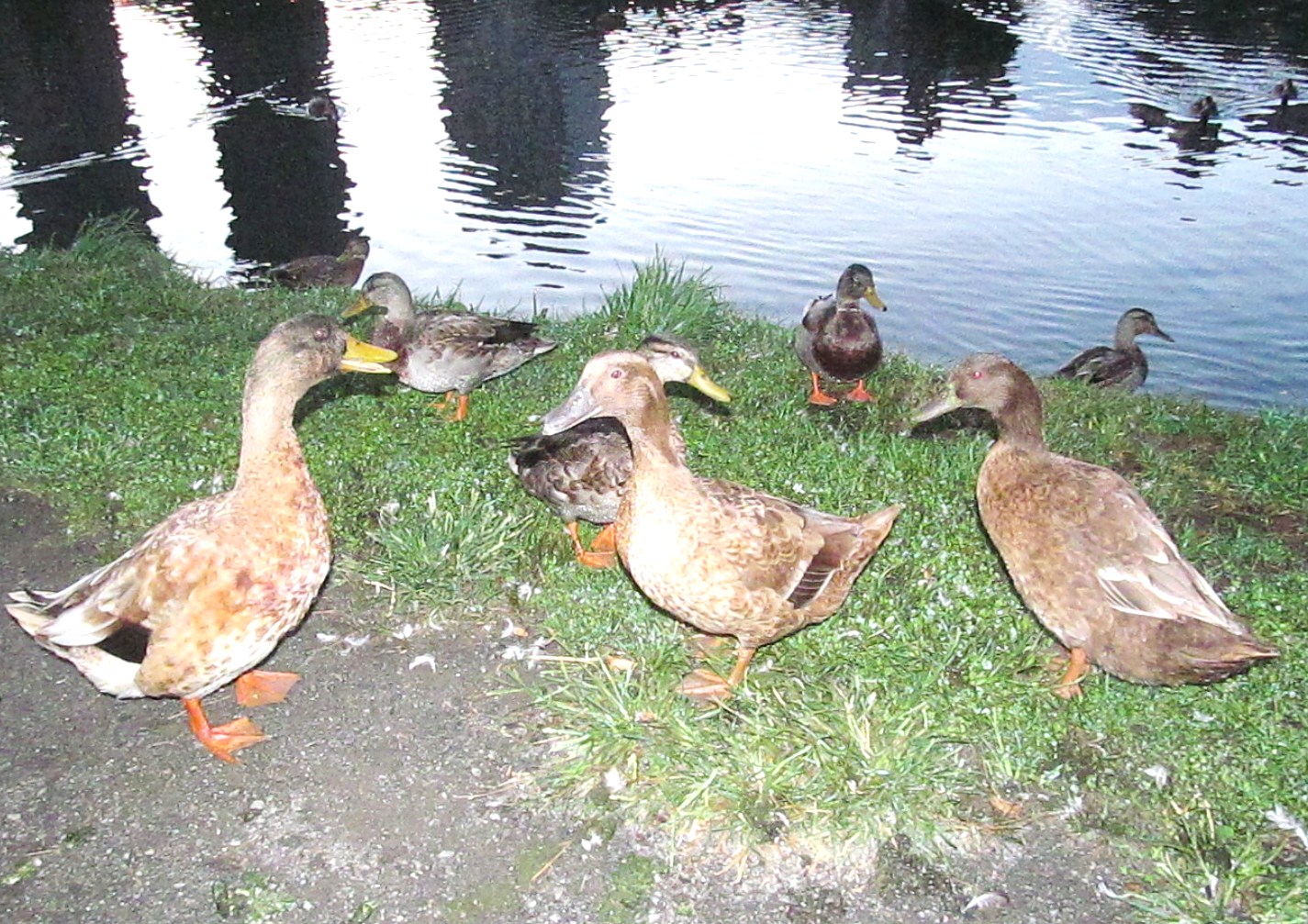
 (Photos: 1-- Danny today at Harlem Meer.  Taking in day on tiny "island" in middle of lake. 2-- Brad and Wiggly enjoying a rare easy and peaceful day.)

"Processing" Blues

The more we learn about "Parkers Poultry Processing" in Dansville, New York, the more troubling the realizations.

For one matter, the bird slaughtering (or gassing) operation is more than 300 miles from New York City and is 6 hours away. 

For another, it has only 5 employees.

Jamaica Bay Wildlife "Refuge" geese were rounded up by USDA between 10AM and Noon on July 9th. These normally cold weather birds were stuffed 4 to 6 into turkey crates on a hot and humid July day and trucked almost 350 miles away.

The crammed geese (on their literal journey to hell), could not have arrived to the so-called "processing" facility until at least 6 PM.  

Assuming ALL 5 employees were there at the time, how could they slaughter or gas 711 geese without going well into the night?   Were they paid overtime?  Is this small time operation open both day and night?

These seem unlikely.

Rather, one suspects the 711 geese were not killed the same day they were rounded up and might have actually spent more than 24 hours crammed 4 to 6 in the suffocating  turkey crates.

Imagine the sheer terror and suffering these birds had to endure even before they were actually slaughtered or gassed?

Though many of the facts still remain fuzzy, the one thing we know without any doubt, is that these geese did not die "humanely" and surely they were not "euthanized."

New York State Director of USDA Wildlife Services, Martin Lowney's repeated  use of these terms in permit request letters to Gateway National Recreation Area and National Parks Services (as well as to the public and press) thus represents inaccuracy and lie.

One has to wonder what else USDA Wildlife Services lies about?
                                                      ------------
Strange Priorities -- The Real Terrors in Our Urban Parks

Claiming them to be the "terrorists" of skies and "nuisances" of parks, New York City has spent hundreds of thousands of tax dollars to round up and massacre more than 4,000 Canada geese in the last three years.

But, who and what are the real terrorists of our parks? 

Does anyone really need to be afraid that they, their children or their grandmothers are going to be molested or harmed in any way by a Canada goose, a raccoon or a squirrel?

But, yesterday in broad daylight, a 74-year-old bird watching woman was beaten, robbed and raped near Strawberry Fields in Central Park:

As a senior citizen who loves observing nature and birds and has frequented this area of Central Park over the past summer, the news stunned and disquieted, but did not shock.

For all the times I have gone to Central Park both day and night, I have never for a second, been afraid of any creature of wing or four legs that might be encountered.

But, I have occasionally seen human "weirdos" (particularly in the Rambles, mentioned in the article) that raise the hairs on the back of one's neck.

Fortunately, I have two dogs that afford me some sense of protection and security.

But, not everyone has dogs.

It is beyond comprehension, our city's  tyrannical campaign against Canada geese -- a gentle, peaceful and completely harmless bird, while seemingly ignoring the real threats to human safety and well being in our urban parks.

Last month, a blind man was struck by a cyclist in Central Park and suffered a broken hip and numerous other injuries and had to be hospitalized.

News of this incident did not surprise me at all as I had been expecting it for a long time.

Walk across or on the Park Drives of Central Park any day or evening and you will think that you are in the midst of the "Tour de France" and surrounded by thousands of Lance Armstrongs racing to the finish line.

The bicycles made today are nothing like the ones I grew up riding upon nor are most of the young men riding them today anything like the kids or adults normally taking their bikes on a leisurely ride.

As said, Central Park has become more like a 365-day,  "Tour de France."

That may be fine for a once-a-year world event in a controlled environment.  

But, if you are a mother with children trying to get across the Park Drive or a senior citizen or disabled person, watch out.

More than once I have seen near misses in pedestrian/cyclist encounters and once nearly had one myself.

One thing for sure:  If you are a pedestrian and are struck by someone going 30 or 40 miles an hour on a bicycle, you are not going home with just a couple of scratches.

Recently, Central Park put up neon, blinking signs in several locations advising cyclists to "obey" normal traffic rules.

But, if a racer training for some cycling event, its unlikely these signs will have much if any impact at all upon the cyclist's riding style and speed.

One needs to be aware at all times of the real dangers and threats in city parks, but they have absolutely ZERO to do with Canada geese or any other non-human animal for that matter.  

Rather,  they have everything to do with the human animal.   

Nevertheless, our spineless Mayor, ruthless Senator and certain park leaderships would prefer to take their eyes off of the real dangers facing the people of our city and focus instead on innocent Canada geese who never hurt or harmed anything and who (most significantly) do not have the power of either voice or vote to protest the tyranny against them.

Strange priorities.
                      --------------

A Rare Peaceful and Picture Perfect Day

This morning I went to Harlem Mere at 10 AM. 

I could not believe the difference in the behavior of the ducks at this particular time compared to other times of the year and day.

Both, in the early mornings and evenings, mallards tend to be wary, constantly alert and jumpy.

Much of the reason for that is due to people's off leash dogs. (Off leash hours in the park are up till 9 AM in the mornings and after 9 PM at night.)

While most people are responsible and their dogs well behaved, there are the occasional nimrods who think it "cute" that their dogs harass the waterfowl and sometimes even jump into the water to go after them.

The result of all that is the ducks are generally very uneasy in the early mornings and late evenings and have to be on constant high alert.

The other times waterfowl has to be on high alert are spring and summer. -- Lots of fishing  and occasional rowdy kids who chase or throw sticks or rocks at the birds.  Lots of human activity, not all of it, gentle and peaceful.

Waterfowl also has to be on high alert in winter, especially when frigid temperatures threaten lakes to freeze over.

In other words, high alert almost all the time.

But, this morning, it was different.

The weather was beautiful and picture perfect.

It was a weekday and school began last week for the kids. 

Most people have to work, so there were few people and no fishermen.

Most of the ducks, including Brad, Wiggly and Honker were resting and happily sunbathing in the small grassy areas surrounding Harlem Meer.

Everything about their posture and behavior said, "Ah, it is beautiful and peaceful today. We can sit back and relax.  We can BREATHE!" 

Many of the mallards actually appeared to be sleeping and dreaming -- something I personally rarely see!

And then there was Danny, the loner goose.

For the past three days, Danny has been staying along the edges of the tiny, plant filled island that is in the middle of the lake.

I am not sure whether this is good or bad news.

It is "good" in the sense that it is a very safe location for the loner goose. Basically, nothing can get to Danny there.  Not dogs, rambunctious kids or fishing lines.

But, it is troubling from the standpoint of its seeming isolation from other bird activities around the Meer -- though occasionally a few mallards hang out with Danny.

But, this morning, even Danny appeared relaxed and quietly alert.

He gazed out over the lake as if, like the ducks, simply enjoying a rare and peaceful day.

Just breathe and take it in.......

And so, like the birds around the Meer, I decided to simply relax and enjoy the day.

Its not too often days like this come around.  -- PCA


                           ************

Wednesday, September 12, 2012

Eradication of New York City Geese the Price for Going Along to Get Along?


(Photo:  Danny, the lone Canada goose at Central Park. Is Danny the victim of "valuable public resource" to USDA Wildlife Services or victim of failure to question?)

The USDA documents acquired through FOIR and posted on (27) GooseWatch NYC (as well as this blog) are revealing in more ways than one.

Most significant are some of the quotes from NY State Director of (USDA) Wildlife Services, Martin Lowney.

In one of his request letters for goose roundup permits, Mr. Lowney writes:

"Resident Canada geese are a valuable public resource with numerous values.  There are multiple benefits for the removal of resident Canada geese from Rulers Bar Hassock."  (Emphasis supplied.)

Maybe it is me and my old and slow brain, but the above does not make sense -- unless the implication is that geese are only "valuable" as a cash "resource" for USDA roundups and "removals."

In another part of one of his permit request letters, Mr. Lowney states, "Also, I must recognize that some patrons will be saddened by the removal of the geese from Ruler's Bar Hassock."

But, then Lowney says nothing more about this either in the rest of the paragraph or the letter.

One gets the unmistakable  impression that although USDA "recognizes" public dismay for goose killings, such "sadness" or dismay is easily dismissed and literally written off by Wildlife Services.  

But, most significant in Lowney's request letters to the leaderships of Gateway National Recreation Area and National Park Service is this:

"I am requesting Special Use permit from National Park Service to capture and euthanize resident Canada geese from Rulers Bar Hassock."

"Euthanize?"

We know from the documents that the geese were sent to an upstate "processing plant" more than 6 hours from New York City. (Apparently one without a published phone number.)

If presumably slaughtered, there is no way this fits the definition of "euthanize" no matter how loosely the term is stretched, twisted.and applied.

But, even if the geese were gassed, the fact they traveled 6 hours under crowded and heated conditions of summer would not meet any definition for "euthanasia," including the oft quoted (and distorted) "UVMA guidelines."

Lowney is guilty of (at best) misleading the recipients of his letters and at worst, lying to them.

Perhaps the assumption was that no one would dare to question the claims made in the letters and/or no one cared how or where the geese died.

Unfortunately, that assumption seems correct according to everything up to this point.

Apparently, the leaderships of Gateway National Recreation Area and National Parks Service did not question anything, nor did the media. 

As we know now, the permits were granted, 701 geese were rounded up and killed from Jamaica Bay Wildlife "Refuge" and virtually all the major media failed to report the goose massacre from a national wildlife refuge, most notably (and mysteriously), The New York Times.

Fast forward to today when I am personally looking at hundreds of ducks in Central Park and only one lone Canada goose who it is suspected will not survive much longer.

So what are the real prices of failing to question anything and just "going along to get along?"

How about deliberate and exceedingly cruel eradication of certain (to use Lowney's term)  "valuable public resources?"  -- PCA
                                                      

                                 ************

Tuesday, September 11, 2012

USDA Jamaica Bay Goose Slaughter Revisited


(Photo: 1--  A loner goose capable of flying escapes USDA goose roundup from Jamaica Bay Wildlife "Refuge" on July 9th of this year.  2-- Some of the 701 flightless, molting geese who were not so lucky to have power of wing.) 

Thanks to a Freedom of Information Request (FOIR), (27) GooseWatch NYC was able to obtain some of the USDA permits and work documents specific to the roundup and slaughter (or gassing) of 701 geese from Jamaica Bay Wildlife Refuge on July 9th of this year:

There are several points of interest:

* USDA requests permits for far more geese than are actually surveyed.  This is so they are not forced to release any geese after capture for exceeding the permit. Obviously, the intent is that no geese are able to escape or require release.  If this does not indicate that the real goal for NYC resident geese is eventual annihilation, I don't know what does.  

* The cost for "processing" (i.e. gassing or slaughtering) the geese was $6.00 per bird.  701 geese were rounded up from Jamaica Bay, making the taxpayer costs just for goose slaughter from this one location, $4,266.

* This does not include tax money paid for rounding up and transporting the geese.  Nor does it include any money spent for "testing" the geese for possible toxins before "donating" to food bank.   

 In fact, there is nothing in the documents to indicate the geese were tested for anything at all.

The geese were apparently slaughtered (or gassed) at Parkers Poultry Processing in Dansville, New York -- more than 6 hours away from Jamaica Bay Wildlife Refuge!

It defies the imagination to think how the geese were crammed 4 to 6 in turkey crates and forced to suffer long, arduous trips to upstate New York in summer heat.  -- Six hours to be exact and that isn't counting the time they awaited slaughtering or gassing.

And we still don't know whether the geese were in fact,  gassed or slaughtered.  However,  both are horrible and neither represents "euthanasia" by any stretch of imagination or word twisting.

I am personally beyond words on what to say about this -- except to speculate that it partially explains why there is currently only one goose in all of Central Park.

One hesitates to even fathom a guess on how "Danny," the loner goose at Harlem Meer managed to escape what surely seems near total eradication of New York City resident geese. 

Unfortunately, Danny's mate (or family) apparently was not so lucky. -- PCA
                       
                                                      
                                                              **************

Sunday, September 9, 2012

Can a Goose Die from a Broken Heart?


(Photos:   Danny, the loner goose at Harlem Meer.) 

I am concerned over Danny, the "owner of a lonely heart" goose at Harlem Meer.

I am not sure if Danny is in fact the same goose I saw the first week in August who was at the Meer for about a week and then seemingly flew off.

At the time, I named the goose, "Danny" to rhyme with "Annie" another loner goose at Turtle Pond at the time.  I thought the goose to be young and a male. I guessed he might have become separated from his family due to either the challenges of first flights or massive USDA goose massacres that occurred throughout the city during June and July. .

But, a few weeks ago I again discovered a "loner" goose at Harlem Meer.

Not really knowing, but guessing he was the same goose seen a couple of weeks earlier, I have been referring to him as "Danny" but the reality is he could be a different goose and could possibly even be female.

This phenomenon of "loner" geese in Central Park following the molting period  (and grizzly massacres) has truly been bizarre and bewildering -- especially if the goose at Harlem Meer now is not the same one observed early in August.

As noted, geese are flock birds and extremely bonded with mates and families.  The observance of geese as solitary birds is rare and certainly not what one would expect for any length of time barring illness or injury.

Annie left Turtle Pond less than two weeks after her arrival. 

But, "Danny" (if that is really who he is) has been at the Meer since either early August or (if not the same goose), since August 21st -- almost three weeks.

It seems strange that Danny hasn't flown off to seek his mate or family or at least attempted to integrate with the new family of geese who recently stayed at the Meer for nearly a week.

Though he does not appear to have obvious injury, part of me wonders if Danny might be unwell?

Compared to other geese, Danny's body posturing and activity levels appear low and depressed.

But, that could be attributed to grievance over loss of mate or family.

Yesterday, I came across an article about "loner" geese:

One sentence particularly stood out: 

"That (grieving) process can include sequestering itself from the flock, weight loss, and signs of submission to other geese for several weeks following its mate's death."  

All of the above is observed in Danny at Harlem Meer.

Although Danny recognizes and comes to me when I arrive to the Meer, he barely eats anything. Over the past few weeks, it seems his (or her) condition has deteriorated somewhat, though I am not sure exactly how or why.

I was greatly hoping last week that Danny would attempt acceptance into the new goose family that arrived and stayed a few days, but that did not happen.  Rather, as described above, Danny "sequestered" himself from the flock and showed signs of submission. 

The contrast in behaviors and body postures between the tightly knit and "happy" goose family and Danny was in fact, startling.   It was almost hard to believe they were the same species.

On the Call of the Canada Geese FB page today, a member asked if a rehabber has figured out why this goose is alone at the Meer all these weeks.  (25) Call of the Canada Geese .   I answered truthfully that no one has commented on any of my writings about Danny.

If contacting a rehabber, I am not sure what to say.

I am not sure after all, if what I am seeing is attributable to actual physical ailment or an animal deteriorating due to loss and grief.  

Perhaps the question to ask is, "Can a goose die from a broken heart?"  -- PCA


                                 **********

Thursday, September 6, 2012

Back to the Future? -- Longings of a Loner Goose and Human


(Photos: 1-- Brad, keeping his two charges, Wiggly and Honker in line this morning.  2-- Danny, the loner goose, rejecting opportunity and seemingly hoping for return to the future.)

Back to the Drawing Board.

This morning I went to Harlem Meer shortly after dawn.
It was pleasing to see that Brad has apparently "regrouped" his two charges, Wiggly and Honker.  

All three flightless ducks were harmoniously together and remained that way throughout the time I was there. 

It is hoped that Wiggly's tendency to sometimes "wander from the reservation" has been tempered and reigned in with some good old common sense and vigilance from Brad. 

Though the living may seem somewhat "easy" now with the still warm weather, plentiful food supplies and flurry of mallards for security, conditions will change over the next few months.  

Unity and cooperation are critical to the ultimate survival of the domestic ducks.

Although I had been hopeful that Danny, the "loner" goose at Harlem Meer would attempt to join the family of 8 geese who arrived at the Meer last week and stayed for several days, it does not appear that occurred.

The family was no where on the lake this morning.  However, Danny was in his usual location, hanging out with the mallards.

Apparently, Danny is still hoping and waiting to reunite with his own mate or family.  However, that is extremely unlikely to occur.

Danny always appears as a lonely figure on the lake -- especially when surrounded by large flocks of quacking ducks. 

I am not sure if Danny simply lacked the confidence or will to attempt integration into the new goose family or if he is just a foolish optimist.   But, if there was opportunity for him to again find a flock, this was it. 

Though extremely tight knit as a family unit, the lead gander of the group was neither aggressive nor territorial. 

I am not sure if Danny will get such opportunity again to join another goose flock.  Presence of resident goose gaggles these days at Harlem Meer are few and far between. 

Nevertheless, as long as there are plenty of ducks at the Meer, Danny is capable of survival.

It is a lonely existence for him, but it is a choice he has seemingly made.

Back to the Future?

Last night I watched former President Clinton's speech at the Democratic convention.

Although his job and the purpose of his speech was to make the case for the reelection of President Obama, I found myself simply longing for his own presidency to reoccur.

"Ah, that we could only reject the rest of this convention, the debates and the election itself and just put Clinton back in the White House!  We need a return to the center!  We need to return to common sense!

Perhaps I am like Danny waiting and wishing for his family to return.

I will be going to the polls this November not to vote "for" anyone, but rather to vote against candidates whose mandates, agendas and social engineering policies I have viewed damaging to the country over the past four years, including the current President's.

But, perhaps there is hope for 2016?

Though the Democratic party rejected her for President in 2008 in favor of a great orator riding in on a magic carpet, I am hopeful that Hillary may again run for the White House.

It appears Danny, the loner goose and I have a few things in common.

We both want to go back to the future.  -- PCA


                                 **************
.

Wednesday, September 5, 2012

"The Last Four Years" -- A Disaster for Geese and Other Life Forms


In a Letters column today from Virginia is the poignant and troubling story of an elderly couple who had enjoyed families of tame and wild geese on private property for many years -- only to realize that the geese and their babies were secretly rounded up one recent summer evening and gassed by Fish and Wildlife Services: 

http://www.delmarvanow.com/article/20120905/ESN02/209050365  (Please scroll down page to "Disappointed in Death of Geese.")

While the bereaved couple expresses hurt and anger over the loss of their "pet" geese, they also express the hope that such incidences never occur elsewhere.

But, the fact is these clandestine government slaughters occur nearly all the time.  

As anyone who has read this blog or Call of the Canada Geese FB page ((25) Call of the Canada Geese)  knows all too well, such goose roundups and killings are now alarmingly common throughout the United States.

They occur in cities like New York, Birminghman and Madison and they occur in small communities like Delafield, Wisconsin or the town the letter is from.

Nor, does it matter the number or type of geese who are rounded up and killed.

As few as 5 Canada geese have been rounded up from some areas and obviously from the letter, white, "tame" geese are rounded up, as well as their wilder cousins.

The bottom line is that throughout our nation in recent years, people have awoken in community after community to realize clandestine government intrusions into their local parks or private properties to round up and kill wildlife -- in many cases, wildlife that the people have grown to know and love.

As a private citizen who has been following and reporting on this issue for at least two years, I am horrified with the frequency, sneakiness, cruelty and senselessness of these middle-of-the-night government attacks on nature.  

But, I am even more alarmed with the total lack of respect shown to the voting public, the human citizens of our country -- as well as the writers of the Constitution.

This is not government "by and for the people and with the consent of the people."

Rather it appears, government run amok or "FDR on steroids."

Recently, the question has been raised on political fronts, "Are we better off over the last four years?"

Putting aside the obvious and troubling economic implications of the querie, there are other quality of life issues that need to be examined when asking ourselves this question.

And from that vantage point, the unequivocal answer is, "no."

Certainly, for Canada geese and millions of other animals and wildlife, they are not "better off" now than they were four years ago.  Resident Canada geese are apparently and secretly  targeted for near annihilation in our country under current political leaderships.

As for the citizens who care about things like transparency in government, reigning in of government waste, intrusion, and expenditures and protection of nature and wildlife, the past four years have been nothing short of an unending nightmare.

The grim reality is that the past four years have become a horror and all the fancy, flowery speeches in the world won't change that.

Perhaps it is wrong to blame the current President for things that occur on local levels or decisions that might not be directly or entirely his.

However, President Obama appointed Secretary of Interior Salazar, whose decisions and calls have resulted in many of the goose slaughters over the past four years, including the killings from Jamaica Bay Wildlife "Refuge" this past July at the bequest of Senator Gillibrand (D) of New York.

I never thought I would personally see the day when I would be worrying over protecting the little wildlife that survives in Central Park (and New York City) from a federal government roundup and slaughter, much less devoting a blog to this issue.

But, that day arrived more than two years ago and to this point, Canada geese have been rounded up and killed by federal government from almost every corner of New York City,  but Central Park.

I will thus be voting against every current political incumbent this November -- something I have never done in more than 40 years of voting.

For if it be true that the "best predictor of future behavior is past behavior" then I surely don't want or support repetition of the past four years. 

Our resident Canada geese will simply not survive another four years of this administration and quite frankly, neither will my senses of peace, "hope" or well being.   -- PCA


                                 ********** 
.

Tuesday, September 4, 2012

Fall Into Food -- The Challenges of Changing Season for Resident Ducks and Geese


(Photos -- 1-- Brad, the domestic Rouen duck at Harlem Meer who has his work cut out for him in more ways than one over the ensuing days and months. 2-- Brad, watching over his charges,  Wiggly and Honker.) 

Domestic Animals Abandoned to Semi-Wild Environments

Apparently, the phenomenon of domestic ducks abandoned in public parks is not unique to Harlem Meer.

Today, there is this article attempting to bring attention to the special problems domestic waterfowl face when dropped off in alien and challenging environments:

Recently, three (new) domestic ducks showed up at the Boat Lake in Central Park.

While I have not personally seen the ducks, I was told a couple of weeks ago by birders in Central Park that a man had claimed to "rescue"  a couple or rabbits and three domestic ducks from slaughter and released the animals around the Rambles in CP.

Today, part of this information was seemingly confirmed in a conversation with Lianna who  monitors the birds at the Boat Lake in Central Park.

Lianna described what sounds like three domestic ducks that she has been seeing on the Boat Lake for the past week or so.

"They are larger than the mallards, reddish brown in color and don't have the stripes of the mallards." Lianna told me.  "The three ducks are always together and I don't think they can fly." she added.

While it is good that the ducks have each other to try and survive as a flock, they are vulnerable to possible dog attacks and other hazards in what is to them, a new and unknown environment.

I advised Lianna to keep a special eye out for the domestic ducks and to aid them in obtaining food.

"Their chances of survival are pretty good depending on how quickly they can adapt to the changes and threats in the location and provided the lake doesn't entirely freeze over in winter." I told Lianna.

Survivability for the rabbits reportedly dropped off in the Rambles is far less likely.

Lacking the ability to escape to water, the rabbits are far more vulnerable to predation from either hawks or dogs. 

Unfortunately, people don't consider these dangers when dropping off domestic animals in public parks.

Brad -- The Exception to the Rule

That Brad, (the domestic Rouen duck left at Harlem Meer at least 4 or 5 years ago) has survived so long in a semi-wild environment is testimony not to the usual, but rather the exception to the rule. 

Brad is both amazingly lucky and more importantly, exceptionally smart, calculating and wary.

Unfortunately, I cannot say the same for Wiggly and Honker, the other two domestic ducks abandoned to the Meer over the past year and currently flocking with Brad.  

As noted previously, I worry over those two.  

Neither Honker nor Wiggly seem to realize as acutely as Brad, the ever present dangers and uncertainty of life in the "wild," (though Brad makes every effort to teach them).  
Last night, Wiggly was back in the fold and Brad watched over her like a hawk, never taking his eyes off her.

Wiggly was none too pleased with all the new focus and surveillance and quacked loudly in seeming protest.  

For a duck who never opened her mouth for nearly ten months, Wiggly has certainly made up for lost time.

She and Brad were once again engaged in highly animated conversation with Honker mostly staying out of the fray and nibbling sunflower seeds from the ground.

I am not sure what Brad has to do to get through to Wiggly the importance of constant vigilance, unity and preparation for the future. 

With her recent rise in status and confidence, (as well as the ease of spring and summer),  Wiggly apparently feels a sense of greater independence.  But, that can be dangerous for flock birds and especially domestic birds incapable of flight should real threat emerge.  

Brad understands these things all too well.  But, Wiggly still has a great deal to learn if she is to survive over the next year and beyond.    The fact is, Wiggly is a kind of airhead.

Fortunately for her, Brad is the exact opposite.

I don't believe there is ever a minute, (be it summer, spring, night or day) that Brad lets his guard down, takes unnecessary chances or ceases to consider the challenges of the days and months ahead.

The fact is, Brad is always plotting ahead.

And more evidence to that was clearly visible last night.
                                                      
Fall into Food

Though the weather in New York City remains mostly warm and sticky, the seasons have already changed in the heads of Brad and billions of other birds.

This recent article describes bird migrations this time of year and the needs for "calorie loading" for the stresses of long flight:

However, it is not just migratory birds who need to load up on nutrition during the fall, but resident birds as well.  

This is in order to build up fat reserves to get them through the lean times of winter when food is less plentiful and the rigors of brutal temperatures taxing on the body.

It is common in winter to see ducks and geese hunkered down on ice with nary a blade of grass in sight.  In order to survive, they need to have nutritional reserves for those times they may not eat for days.

Already many of the mallards and geese are reacting and preparing for the changes in season, none more so than Brad.

Throughout the spring and summer, Brad and the other ducks have been welcoming, but not needy of treats.  Though Brad is accustomed to taking sunflower seeds from my hand, he did this sparingly over the warm months.  Additionally, knowing the bounty of food available to the ducks over the spring and summer, I did not go to Harlem Meer everyday. 

However, over the past week, things have dramatically changed.

As if the season suddenly changed in his head, Brad is the first bird to waddle to me when I arrive at the Meer with the others following close behind.  Moreover, fully knowing he can get far more food by directly eating from my hand, Brad wastes no time in reaching up to me beseeching treat.

Though I know he is not starving, I oblige Brad for all the obvious reasons.   It is important that he stay strong and healthy in order to help the other two domestic ducks survive. Brad knows he has to "calorie load" now, just as the mallards and geese do.

Though the temperatures have remained warm and summer-like in New York City, I have experienced the past few nights to be reminiscent of winter with a cluster of "famished" mallards scrambling at my feet and one domestic duck greedily swooping treats from my hand.

This has nothing to do with Brad's or the mallards "attachment" to me personally or even that they are particularly hungry right now.  

Rather, it  has everything to do with the change in season and the birds' awareness of how they have to prepare now for the stresses of winter soon to come.

"Fall into food" is the overriding priority now. Get it while and when they can.

That is not just true for the migratory birds, but every bit as much (if not more so) for the resident ducks, geese and others who have to tough it out in a hostile environment over the winter.   -- PCA


                                 **************