Monday, February 16, 2015

Little Warmth of Heart for the Weary and the Frozen?


Most of the geese and mallards sitting to warm fast freezing legs last night in below zero wind chills.
As a mallard scratches ice off himself, the little female wood duck sandwiches herself between the ducks and geese to try and eat and conserve body heat.
 The good news yesterday was that I saw no dead bodies on the ice at the Central Park Reservoir.
.
The bad news was that all the water birds were clearly suffering in the single digit temperatures and below zero wind chills.
.
Both, the geese and mallards had difficulty flying through the powerful winds and walking was even more taxing on the bitterly frigid ice. The geese and ducks could not stand or walk for more than a few seconds before having to squat down to warm their feet and legs. Several of the geese were limping. A number of the geese and mallards did not even make it to the area I was tossing food, though all attempted.
.
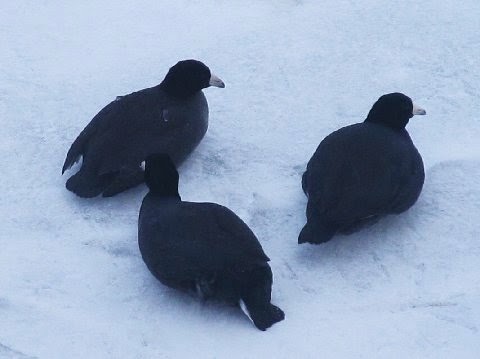
Last night one coot made it over quickly to grab a couple of morsels of nourishment, but then immediately flew back to the "warmth" and safety of a small pool of open water.
.
So brutal was it last night, that none of the mallards flew up to the running track to grab loose food pellets that had fallen. Like the geese, they mostly sat down and stretched their necks out to eat as much as they could, as fast as they could. Even the little female wood duck, sat frozen on the ice, rather than venturing on the snowy embankment as she usually does to get an advantage for food.
.
We lost three birds on Saturday.  A coot, a mallard and a goose. These are only the birds I'm aware of (going to the location twice a day now). But, I don't stay long as one simply cannot linger in a deep freeze for any amount of time. For both the birds' sake and my own, I am there and gone quickly.
.
A couple of days ago, I posted a request on the New York Birders Facebook page that others pitch a helping hand to the struggling waterfowl on our frozen lakes and ponds during this unusually bitter spell. Several people countered that "nature should take its course" and that it is only the "weak" or mentally unfit that will perish. That may be true, but it seems a bit callous and cold hearted -- especially when there is opportunity to aid suffering wildlife through an unusually harsh period. Would these same people walk by a bird entangled in fishing line and say, "let nature take its course?"  Many scientists are making the argument that it is human actions and footprint that are causing most of the extreme fluctuations in weather and destructive impacts to wildlife. (i.e. climate change.)  So should we not counterbalance some of that destruction by helping the animals when we can? 
.
Ironically, birders are among the people who most bitterly complain about cats killing birds. But, many would sooner see a bird starve on a frozen lake than offer a food pellet. Something seems a bit contradictory in that. One could, after all, argue that when a cat kills a bird, it is "nature taking its course" or "natural selection" -- the bird must have been weak or mentally unfit.
.
Anyway, I am whining. Perhaps I am simply vexed and frustrated seeing so many photographers and birders taking advantage of the birds coming to me for food to take opportunistic photos for themselves. Said I to one a few days ago, "Gee, its nice to take photos, but can't you offer them a little food during these tough times?"
.
One of the few pleasantries of the past two particularly brutal days, is that I did not encounter such people with their huge cameras and peering eyes or I might have said, "You want to know where the dead bodies are?" 
.
Despite all the stresses, there was something blissfully, if not mournfully peaceful about the past two days.  
.
Still, today will be worse.
.
It is currently 3 degrees and I have no idea on what to expect in a few hours. I just pray that all my little friends will still be safe and alive as there is hope around the bend.  
.
By next Saturday, we should be back up to near freezing in New York City. -- PCA
.
.
.
                                                      **********.

Saturday, February 14, 2015

The First (known) Casualty During New York City's Arctic Freeze


Rest in peace, little coot. Ice, cold and starvation took its toll.
But, for the living, it is another day of struggle and holding on.
The bold and risk-taking mallards on icy running track.

When going to the Central Park Reservoir during these days of "Arctic Freeze," I try to prepare myself for anything.
.
Certainly, I have seen the struggle of the ducks and geese, especially over this last week of frigid temperatures and dwindling food supplies and open water. A few of the birds have appeared weak and disabled and I have had to assume that hawks or other predators are picking off the weaker ones when I am (thankfully) not there to see.
.
But, I wasn't really prepared to see the dead coot, frozen in the ice and snow along the south embankment this morning.
.
The image stung my soul and I could not help but question if there was something I could have done to prevent this pitiful and sad loss?
.
There are not many coots at the Reservoir. Just a few. Like the mallards and geese, they usually come seeking food when I am there. But, because they are slow and cannot compete with the much quicker mallards, I am unable to get much to them, despite earnestly trying.
.
Coots generally feed on aquatic plants, algae and small aquatic animals of which, there are virtually none at the nearly iced over Reservoir right now. Since coots are able to withstand frigid temperatures, I have to presume this little guy (or girl) starved to death.
.
Such is not a comforting thought to one who has been making an effort to get nourishment to the struggling water birds at the Reservoir. A birder on Facebook also informed this morning that a dead mallard was observed at the north side of the Reservoir. Thankfully, I did not see that.
.
Moving away from the dead coot, I proceeded to toss food to the anxious geese and mallards who had quickly gathered at the edge of the embankment. Life, as the saying goes, has to go on. 
.
As usual, some of the bolder (or more desperate) mallards flew on to the ice covered running tract to get first digs at food falling to the ground.
.
Within mere minutes, ever morsel of dry cat food, sunflower seeds, bird seed and whole wheat bread was gone. And yet the geese and ducks were still seeking and actually following me along the ice.
.
Snow is forecasted to arrive later today and by the morning, temperatures are set to plummet to near zero with up to 60 mph wind gusts. In fact, for the entire week, New York City will be well below freezing.
.
I have to consider that the two deaths observed by myself and another birder this morning will not be the last.  Our goal now is to simply try to keep such losses to a minimum. 
.
Rest in peace, little coot.  I regret that we could not save you during these trying and treacherous times.   -- PCA 
.
.
.
                                                      ************

Friday, February 13, 2015

The Toughest Bird to Winter's Wrath?


Mallards scrambling for scattered seeds on running path at Reservoir.
Grabbing what they can, when they can on icy Reservoir.
Hardy little sparrow taking advantage of easy opportunity. 
The cold too much for their feet, most of the geese and ducks squatted down.
The little, female wood duck sitting on ice to conserve body heat.

It was 9 degrees when heading to Central Park this morning, with wind chills below zero.
.
I didn't think it was too bad until hitting the Reservoir path. With no buildings or trees to blunt the fierce force of the winds, it was like stepping on to the Arctic -- complete with rock-hard ice below one's feet and 35 mph wind gusts.
.
But, who am I to whine about the cold or the wind when I am only out for an hour?  

The park wildlife has to endure it 24/7.
.
The remaining geese (32) and ducks (about 50) were all swimming vigorously in the still open water at the otherwise iced over Reservoir.
.
Though at least a quarter of a mile away, the geese recognized me immediately arriving to the path. They came scurrying out of the water, the mallards following closely behind. (It's intriguing how mallards seem to take so many of their cues from geese, regarding predator dangers or in this case, a benefactor. Though the two species don't always "like" each other, they nevertheless rely in many ways on one another through the bad times.)
.
So frigid was the ice below their feet, neither the geese nor ducks could stand more than a minute or so before having to squat down to warm their legs and contain body heat. Although pangs of hunger were obvious, most chose to stretch their necks out to grab treats falling on the ice, rather than stand and scramble for them which actually appeared painful.
.
Unrelenting winds blew much of the bird seed I was tossing, back on the running path, where clever and opportunistic sparrows were quick to swoop down and grab them. It's interesting to note of the wildlife having to deal with this bitter and unusual cold, sparrows appear to be the most resilient and less bothered by it. The sparrows cheerfully hopped around as if it were a perfectly, ordinary day. The ice did not appear to chill their feet or bodies in the least as it obviously was, the geese and ducks.
.
Back on the Reservoir, the geese and ducks were still struggling. The geese have longer necks to reach the food, but the mallards were quicker and extremely deft -- sometimes boldly stealing a piece of bread right from a goose's mouth. This prompted an annoyed reaction from a couple of the geese, even pecking the little female wood duck who has been hanging with them over the past couple of weeks.
.
It was about that time, that despite the warm gloves on my hands, my fingers became numb and tingly, prompting an awareness of frostbite. Though I had only been standing about ten minutes, it was apparent I needed to pack up the feeding action and stuff hands back in pockets.
.
All the food on the ice gone, some of the mallards took to the air, flying over the fence to grab any remaining sunflower or bird seeds on the running path. From their bold and risky (or maybe, just desperate) moves, I gratefully surmised that the two red-tailed hawks observed yesterday morning weren't around today. If true, at least the water birds got a bit of a break.
.
Finally exiting what had seemed a visit to the North Pole, I passed a small tree with many branches. There, skipping and singing among the twigs, were the merry little sparrows.
.
Who would ever think that it is the diminutive sparrow who (most times, we don't even notice) would ultimately be the toughest bird to winter's wrath?  -- PCA
.
.
.
                                                       **********
  

Thursday, February 12, 2015

SOS: PLEASE FEED Water Birds as "Life Threatening" Arctic Freeze to Hit NYC!


Relegated to tiny refuge of still open water at the Boat Lake in Central Park, the ducks and geese are desperate for food and appear more than aware that the worst is about to come.
Feeding frenzy at icy Boat Lake yesterday.
One of three, domestic (flightless) ducks at Boat Lake.
Geese on frozen Reservoir.
Scrambling for best position.
One mallard flies to top of embankment for better access to food.
A goose at top of embankment despite slippery grip.
Finding tiny pool of water to warm up feet.
Mallards on running path at Reservoir.
A one-legged goose at Reservoir. One can only guess how this disabled bird is surviving.
 
It's long been speculated throughout this blog that water birds are acutely aware of dramatic weather changes before they actually occur.
.
At no time has that been more apparent than yesterday in Central Park.
.
The only time I have seen ducks more desperate for food was during last winter's record snow storms in New York City. (Thousands of ducks and swans starved to death last winter throughout the northeast.)  As recorded then, so hungry and desperate were the ducks, they literally tripped over themselves at my feet and grabbed food from my hand.
.
I saw the same behavior -- and more -- yesterday both, at the Reservoir and the Boat Lake in Central Park.
.
Mallards scrambled over themselves to get to the food and even poked their heads through the fences to scoop up stray seeds on the ground. Others batted my hands, trying to gain advantage over those just eating from the ice.  The geese too, were flying and scrambling to get to whatever they could as fast as they could. And though geese have usually been passive with ducks throughout the winter (allowing mallards to grab most of the treats), yesterday I noted several geese actually battling to fend the mallards off.
.
Desperate times are calling for very desperate measures.
.
Weather forecasters are predicting "life threatening" cold in New York City, starting today and lasting through Tuesday. That is five days of wind chills of 20 below zero, more snow and temperatures that will dip to near zero and fail to get out of the 20's.
.
Already the tiny pool of open water at the north west part of the Boat Lake in Central Park has shrunk to about a dozen feet as a cluster of mallards and a few geese take refuge there. Particular concern is for the three domestic (flightless) ducks who are basically marooned on this tiny oasis should the whole lake freeze over this weekend. There is absolutely NO food for these birds on a frozen lake with grounds covered in ice and rock hard snow.  
.
Yesterday, when arriving at the Boat lake, there were several people standing around taking photos of the desperate birds. But no one offered food.
.
When the ducks and geese clustered around me in what was a feeding frenzy, the people delighted in the unusual photo opportunity.  This prompted me to request that the next time they come to the park, to bring some food for the birds.
.
"These are water birds who have no water right now from which to obtain food." I said to two young women. "And you see grounds are covered in ice and snow.  That is why the birds are so desperate and you are seeing this frantic behavior. Unless receiving some support, some of these birds are likely to die over the frigid weekend."   
.
I don't know that the pleas will work. But, I am also putting it out in this blog today.  If you live near a city park, please go today or over the weekend to distribute as much wild bird seed, bread, rice, corn, sunflower seeds or dry cat food as possible. Its not exaggeration to say, the birds are literally dying for it.
.
Though I normally go to Central Park once a day to monitor and offer nutritional support to our struggling waterfowl at the Reservoir, yesterday, I went twice.
.
The ducks and geese were even more desperate last night than they were in the morning. The second they saw me making my way on the Reservoir path, they flew, slipped and scrambled to get into position to grab what they could.
.
A number of mallards flew over the fence to fetch stray seeds on the ice-covered running path. I attempted to hand-feed a few, but so frantic were they, they chopped down on my fingers in their desperation. A couple of geese also flew atop the ice-covered embankment, despite the slippery conditions. 
.
When all food was gone, the geese and ducks continued to follow me along the ice, though I made it clear there was nothing left.
.
I have never seen such desperate and totally frenzied behavior before in either the ducks or the geese.  I scrambled to get off the icy Reservoir path at the nearest exit so as not to "tease" the birds further.
.
Finally, those familiar with this blog, know I have been critical of those crusading to ban carriage horses from Central Park. The reasons for supporting the carriage horses of NYC and opposition to the drive to banish them forever from our midst have previously been detailed and do not require further embellishment here.
.
But, at no time have I been more disgusted with these people than yesterday and today.
.
While wildlife in Central Park is clearly suffering and struggling under their noses, yesterday, members of NYCLASS, PETA and other fringe Animal Rights groups marched with protest signs alongside the carriage horses at Central Park South:
.
.
What animals do such negative and destructive actions actually help?
.
The carriage horses will be brought inside their stables this weekend when temperatures fall below 18 degrees. The horses are provided with warm blankets and the best in nutritional and veterinary care. Most importantly, they have safe shelter and care from people invested in keeping the horses healthy and happy.
.
The wildlife in our parks have none of these things as temperatures and wind chills are about to plunge to record levels over the next five days. Over the past several weeks, I have twice noted a one-legged goose at the Reservoir. One can only guess how this disabled goose has managed to survive so far, but for certain, it is a desperate and nearly impossible struggle.
.
It would have been nice if the estimated 30 carriage horse protestors put down their signs yesterday and instead of whining and criticizing, distributed some feed to the desperate and needy water (and other) birds of Central Park. But, instead, it was deemed more productive to "protest" the objects of their so-called "pity" and pose for photographs.
.
If that doesn't scream narcissism and disengagement, I don't know what does.
.
What is Animal Rights after all, without care for animal welfare?
.
The birds and other wildlife of our city parks are fully aware that they are in for a very rough and life threatening time over the next five days.
.
If you care about animals at all, please visit local parks and distribute whatever you can in the way of nutritional support for the birds and other wildlife. 

If the animals could talk, they would tell you they care far more about their empty bellies and trying to hold on to the gift of life than they do any "rights" you could proselytize about or fancy photos you could take. -- PCA
.
.
.
                                                 ***********


Tuesday, February 10, 2015

Rolling in the Deep Freeze, The Birds Hang Tough


"Liliana's Boy" -- Domestic Rouen duck hanging tough at frozen Boat Lake in Central Park.
Hungry mallards and geese at Boat Lake.
A frozen wonderland with just a tiny pool of water.
Despite the cold, this sparrow taking a bath.
Ice landing at the Reservoir.
Three coots on icy Reservoir.
Female wood duck hanging with the geese at Reservoir.
Geese and coots at Reservoir.
 
This past Sunday, I went to the Boat Lake in Central Park and was relieved to find the three (flightless) domestic ducks still hanging tough at what has become an entirely frozen wonderland with the exception of a tiny pool of open water to the north west side. (As previously noted, my friend Liliana has been sick with the flu over the past ten days and was not able to feed and monitor the birds at the Boat Lake. Thankfully, she is slowly recovering now.)
.
But, it wasn't just the three domestic ducks taking refuge at the small open water spot, but also, a sizable number of mallards and ten geese.
.
This suggested that (as Liliana and I had hoped and anticipated) other people were aware of the vulnerable birds and apparently taken to providing them with some sustenance over this particularly challenging time.  
.
The good thing about this particular location at the Boat Lake is that the ducks and geese are highly visible to many people passing through on a daily basis. 
.
In that sense, the Boat Lake is very different from the Jackie Onassis Reservoir.
.
Although a very popular location for runners and people strolling during fair weather, the Reservoir is probably the coldest and most inhospitable area in all of Central Park during winter. For one matter, the running path surrounding the Reservoir is never plowed. Result is that new snow piles upon old snow and all becomes ice with just a few snow storms and consistently frigid temperatures. 

Another problem is the wind. Because it is wide open space, there is nothing to block winds blowing across the Reservoir. While a very attractive feature on summer evenings when soft breezes are welcomed in steamy New York City (and always make the Reservoir feel ten degrees cooler than the rest of the city), in winter, the unblocked winds are just brutal and unrelenting. 
.
During the past few weeks, there have been very few people venturing around the Reservoir.
.
While the peace and serenity is very refreshing to this otherwise hardened New Yorker, I am also relieved that the three domestic ducks are not located at the Reservoir as they would surely be dead. Thankfully, they apparently have more than one fan at the more traveled Boat Lake and the winds are much more gentle there.
.
It would be nice to think that the worst is over, both for the domestic ducks at the Boat Lake and the rest of the ducks and geese in New York City. Normally, by mid February, things begin to warm up a bit and the migratory geese wintering in Central Park take off to return to their homes far north.
.
But, it is hard to imagine any of this happening any time soon.
.
Another "polar votex" is predicted to descend on the city by this Friday and temperatures are predicted to plummet to their lowest points all winter. (As low as 2 degrees through the weekend.)
.
This morning, there were not as many geese at the Reservoir as I am used to seeing over the past month.
.
But, I can't be sure if that is due to them needing to find food before they migrate back north or whether most just took off ahead of the polar vortex and left town all together.
.
Stay tuned.
.
                                                  **********

Thursday, February 5, 2015

No Early Spring According to the Geese


The only open water area at otherwise completely frozen Reservoir in Central Park. The geese and ducks adapt to constantly spraying water of water spout -- but in this case, a blessing.
Slip, sliding away on the ice.
And squatting down to keep feet warm.
Scrambling for any morsel of treat.
A frozen wonderland.

The picture was bleak and a bit treacherous walking around the Jackie Onassis Reservoir this morning. New snow had piled upon old snow and all was covered by a thin coating of ice. It made the going slow, slippery and uncertain. A cutting and strengthening wind didn't help to lesson the feeling that winter was merely in the middle of its gathering grip and was not about to let go anytime soon. 
.
Though at casual glance, the frozen wonderland appeared devoid of life, closer inspection revealed numerous, small, dark objects clustered closely together on the ice. They were the geese, ducks and sea gulls gathered around what had become their last refuge in Central Park -- The now tiny area of open water created by the constantly spraying water spout.
.
Immediately upon seeing me walking in the distance, the birds came flying or skidding across the ice in desperate search of a morsel or two of treat. I felt both, important and impotent at the same time. So many of them and only one of me. What possible difference could one make? And yet, for those few lucky birds I could represent a moment of relief, it was worth the effort --regardless of how anemic such effort was in reality.
.
My friend and fellow goose and duck lover, Liliana, has the flu.  She has been sick for more than a week and unable to leave her apartment. I offered to bring her soup, but of course she won't hear of it. Liliana is a very proud woman who vehemently rejects any "favors." Fortunately, she has a brother who has apparently been helping her out through the illness.
.
I have been wanting to go to the Boat Lake to feed and monitor Liliana's three domestic ducks. But with more than 200 geese and almost as many mallards at the nearly frozen Reservoir now and all of them completely desperate, it has put ventures elsewhere out of the question. Central Park is covered in ice and snow and all watercourses virtually frozen solid.  We have to hope that someone else is feeding the three flightless and vulnerable ducks at the Boat Lake, but who knows? It seems the only thing brought to any birds at the Boat Lake is daily harassment by Geese Police.
.
Fortunately, the one place in Central Park, Geese Police doesn't go is the Reservoir as they don't have easy access to it. Thus, it is the one watercourse virtually all of the migratory water birds take refuge.
.
As noted, there is a water spout towards the southern portion of the Jackie Onassis Reservoir.  Normally, the geese and ducks don't congregate near the fountain because the constantly spraying water is unpleasant. With the exception of last winter, normally the birds don't have to, as there are usually other open water areas they are able to work at and maintain.  But, with the rest of the Reservoir, completely iced over now, it is the only area with open water and so once again, the birds are forced to adapt.  All the geese, ducks and gulls were congregated around the fountain this morning, spray and all. It's all they've got now. Desperate means call for desperate measures.
.
"Desperate" is now the term to describe the geese, as well as the ducks.  Normally, the geese would be moving around the lawns in Central Park this time of season to feed and calorie load in preparation for migration in a week or two.  But, with about a foot of hard packed snow covering the lawns, grass is very hard to come by. I have seen very little movement among the geese in the last few days. They and the ducks are virtually marooned and very much "hunkered down" at the continually shrinking open water spot at the Reservoir.
.
Much is made every year about groundhogs predicting whether we will have an "early spring" based on whether they see their shadow or not. I can't personally speak to that, but am suspecting on basis of behavior of the geese, that we have at least six more weeks of winter. Though there have been a couple of small signs of spring stirrings, for the most part, the geese are a little behind schedule in terms of migratory preparation. Spring seems the last thing on their minds as focus is on mere survival.
.
We are plummeting down to single digits in NYC tonight with below zero wind chills. More snow is expected over weekend.  Though much was made about last winter being so brutal with all the record snow, this winter has been colder than average in New York City. If going by the geese, it seems we have a long way of winter to go. Instead of lawn hopping and dominance battles, I am mostly seeing huddling and squatting down on ice.
.
Who can, after all, think of mating rituals and migration calls, when you're just trying to keep your feet warm?
.
According to the geese, there will be no "early spring" this year. -- PCA
.
.
.
                                                  **********

Sunday, February 1, 2015

Spring Peeking Through the Bone-Chilling Air? -- To Some of the Geese, It Is!


Geese and mallards hunkered down on mostly frozen Jackie Onassis Reservoir in Central Park, as temperatures plunge and more snow on the way.
But, a first sign of spring as two ganders battle over mating rights?
Display of dominance?
"Time to eat guys, as migration not that far away now."
It takes some tough ducks and geese to opt to winter in New York City during the harshest weeks of winter. They have to quickly adapt to snow, iced over watercourses and temperatures that sometimes plunge to single digits. 
.
While the snow fall of this past week was not the "historical" epic disaster predicted by Mayor deBlasio, it nevertheless left city parks blanketed by a coating of what now is mostly, tightly packed ice.
.
Additionally, the city is in the grip now of an "Arctic Freeze" and more snow is forecast by tomorrow morning.
.
As open pools of water have all but frozen up at the Jackie Onassis Reservoir in Central Park, the geese and ducks are surprisingly and stoically hanging in there. Fortunately for them, there is some type of underwater fountain that constantly springs up fresh water in the middle of the Reservoir. So, even when the Reservoir is otherwise iced over, there is always a pool of open water surrounding the spout. And it is around there, that the birds now congregate, as their last seemingly open water refuge in Central Park.
.
Over the past month, the geese, mallards and few coots have learned quickly how to navigate the ice without slipping too much, huddled closely together for warmth and when necessary, they take turns swimming to try and maintain open water.
.
But, one cannot help but wonder what they do for food?
.
With grounds covered in snow, watercourses iced over and little in the way of plants and grass, it seems meager pickings for the birds to sustain themselves over the deep weeks of winter.
.
But, I have noticed something over the past few years of observing migratory Canada geese who winter in NYC and specifically, the Reservoir.
.
That is, that they don't appear to be that desperate for food, despite the obvious short supplies.
.
This has prompted one to wonder more than once, if geese are able to somewhat suppress their appetites over the tough weeks of winter as some other species (particularly those who hibernate) do? 
.
I have never read anything to this effect, so I cannot say for sure. (However, during last year's particularly brutal winter, thousands of ducks and swans were reported to have starved to death along the east coast and Great Lakes, but not so many geese.)
.
From all appearances, it seems geese mostly "hunker down" in winter, moving and flying very little and seeming more concentrated on conserving calories and energy, rather than wasting them in active searches for food.
.
Mallards, on the other hand, don't seem as adept at conserving energy and calories as geese and rather are much more desperate for food.
.
While both the geese and mallards come each evening when I toss some cracked corn, sunflower seeds and even a little whole wheat bread on the ice, the need of the mallards is far greater and more urgent than that of the geese. The geese are almost blase about the food offerings and consistently allow the mallards to grab most of it. (Other times of the year, geese will peck at and chase off mallards who compete with them for food. But, not in winter.)
.
So, why is this?  Do geese suddenly become charitable and generous in winter, passively allowing mallards to gobble most of the food? Or, do they figure that they actually need or desire the mallards around to help maintain open water and provide warmth? Or, are they simply able to suppress their appetites? I am not sure of the answer to this, but perhaps, like so many things, it might actually be a combination of all three possibilities.
.
I do know this situation is however, very likely to change and change very soon.
.
Though they are the last geese to migrate in winter (typically arriving in late December or early January), the wintering Reservoir geese are the first to migrate back home, typically leaving Central Park in mid February.
.
But, before departing on long and treacherous journey, the geese have to calorie load.
.
Usually, a week or two before migration, the geese prepare themselves, by flying to the nearby North Meadow (or other grassy locations) to spend evenings grazing on whatever grass remains.
.
So far, I haven't seen actual evidence of that happening yet, though over the past few days, I have noted several flocks of geese flying into the Reservoir around sunset.  That suggests that some of the geese might already be moving around and starting the fattening up process.
.
But, for the moment, most of the geese still appear to be in "hunkering down" mode with little visible expenditures of energy and little urgent need for sustenance. (In fact, I sometimes think the main reason the geese come to me at all is mostly for social greeting, rather than desperate need for the treats I bring.)
.
Still, even that may be showing the first sign of change.
.
Last night, one of the ganders, in what might be one the first displays of battling for mates, picked a brief fight with another gander and chased off several others.
.
Hm, despite the frigid temperatures forecasted for this week and next, could spring actually be peeking through the bone-chilling air?
.
At least to some of the geese, it seems to be.  -- PCA
.
.
.
                                          **************